breadcrumb arrow breadcrumb arrow
Read news
Key Sanctions Highlights in Q2 2026
04.08.2026.

SUMMARY

  • The European Union (EU) has expanded its sanctions lists in response to Russia's war against Ukraine. It has imposed sanctions on several individuals and entities involved in the unlawful deportation and forced transfer of Ukrainian children to Russia.
  • The Court of Justice of the European Union (CJEU) has clarified that assets placed in a trust must be frozen if the sanctioned person retains the ability to control or benefit from those assets.
  • 24 new criminal proceedings have been initiated in Latvia for violations of international sanctions.
  • During Q2, the Financial Intelligence Unit of Latvia (FIU Latvia) received 359 suspicious transaction reports regarding suspected sanctions violations or attempted sanctions violations.
  • Latvian courts concluded four criminal cases involving sanctions violations, imposing fines and ordering liquidation of a legal entity.
  • The Customs Board of the State Revenue Service (SRS) initiated 52 administrative offence proceedings.
  • FIU Latvia has published updated guidelines "Assessment of control of designated public officials".


Strengthening of Sanctions

On 11 May, the Council of the EU adopted sanctions against an additional 16 individuals and seven entities involved in the unlawful deportation and forced transfer of Ukrainian children to Russia. According to the EU, the sanctions target persons and institutions involved in the systematic, unlawful deportation and forced transfer of Ukrainian children, the so-called militarised “re-education”, and unlawful adoption practices. The sanctions apply to Russian officials and politicians, children's centres, youth organisations, and other entities facilitating the integration of Ukrainian children into the Russian system.

On 15 June, the Council of the EU adopted a decision to expand the EU's sanctions lists against Russia. The changes include additions to the lists of natural and legal persons subject to targeted financial sanctions in connection with Russia’s illegal war in Ukraine, Russia’s hybrid threat activities, and human rights violations. Notably, these additions to the sanctions list were adopted outside the EU’s broader sanctions package.


Key Judgments of the Court of Justice of the European Union

On 21 May, the CJEU delivered a judgment interpreting the obligation to freeze assets under targeted financial sanctions in relation to funds and economic resources transferred by a sanctioned person into a trust. The CJEU ruled that assets transferred into a trust may be regarded as owned or controlled by the sanctioned person ns if that person retains powers enabling them to use, benefit from, dispose of, or otherwise exercise influence over those assets, including the ability to influence decisions made by the trustee in relation to them.

On 11 June, the CJEU dismissed the appeal filed by Russia's National Settlement Depository (NSD) seeking its removal from the EU sanctions list. The CJEU held that an entity's significant role in Russia's financial system and its contribution to the functioning of the Russian state's financial system may constitute sufficient grounds for its inclusion on the EU sanctions list. The Court further clarified that it is not necessary to demonstrate that the entity directly financed Russia's military aggression or specific actions aimed at destabilising Ukraine. Rather, it is sufficient to establish that the entity provides material or financial support to the Russian Government or plays a significant role in the relevant sector. As a result, the CJEU dismissed the appeal and upheld the General Court's judgment confirming that the inclusion of Russia's NSD on the EU sanctions list was justified and should be maintained.


FIU Key Developments

During Q2, FIU Latvia received 359 suspicious transaction reports indicating suspected sanctions violations or attempted sanctions violations. As in Q1, the most common cases in Q2 involved the potential transfer of sanctioned goods to Russia through third countries, the provision of prohibited services to legal entities established in Russia, accounts held with banks included on sanctions lists, and the transportation of cash to Russia. A total of 84 analytical reports concerning potential sanctions violations were submitted to law enforcement authorities and other institutions.

FIU Latvia continues to update the “Frequently Asked Questions” (FAQ) section of its website regarding implementation of sanctions by clarifying existing explanations and adding new information. The updated FAQ section provides explanations on making payments after the end of transitional periods, the application of import bans and transit through the EU, the application of General License, the interpretation of contracts concluded before the imposition of sanctions, trade in goods imported before the imposition of sanctions, as well as restrictions on the provision of management services to legal entities registered in Russia and Belarus.

FIU Latvia has published updated guidelines "Assessment of control of designated public officials". The guidelines have been supplemented in accordance with the definitions included in EU sanctions legislation of “owning a legal person, entity or body” and “controlling a legal person, entity or body”. Although EU institutions had previously provided guidance on the criteria to be considered when assessing ownership and control for the purposes of applying sanctions, these criteria have now been legally established in Regulation (EU) No 269/2014. FIU Latvia’s approach to the assessment of control remains unchanged.

At the end of Q2 of 2026, the following assets owned or controlled by persons included on sanctions lists were frozen in Latvian financial institutions and state registers:

  • Funds – EUR 151.9 million
  • Real estate – 103
  • Vehicles – 66
  • Tractors/self-propelled machinery – 11
  • Watercraft – 1
  • Herd – 1
  • Trademarks – 12

The list of sanctioned persons whose assets have been frozen in Latvia is available here.


Criminal Proceedings Statistics in Latvia

During Q2 of 2026:

  • 24 new criminal proceedings were initiated for international sanctions violations;
  • criminal prosecution was initiated in seven criminal proceedings;
  • charges were brought against nine natural persons;
  • five criminal proceedings were referred to court.


In Latvian Courts

During Q2 of 2026, Latvian courts examined four criminal cases concerning sanctions violations. Judgments in two of these cases have entered into force. In one case, a fine of EUR 10’100 was imposed on a natural person, while two legal persons were subject to coercive measures – one was ordered to be liquidated, and the other was ordered to pay EUR 17’900. In the second case, a decision to terminate criminal proceedings entered into force based on amendments to paragraph one of Section 84 of the Criminal Law, which entered into force on 10 June 2025 and provide for criminal liability in cases where the value of goods is not less than EUR 10’000.

In two further cases, the judgments had not yet entered into force by the end of the quarter –one natural person was subject to probation supervision for four years, while the other was sentenced to community service.


Highlights from the Customs Board

During Q2 of 2026, the Customs Board of the SRS initiated 52 administrative offence proceedings concerning sanctions violations.

To prevent the movement of sanctioned goods across the EU external border, during the second quarter of 2026, the Customs Board refused to apply the declared customs procedures to 185 consignments. As a result, the export of 157 consignments of sanctioned goods from the EU and the import of 28 consignments into Latvia from Russia and Belarus were prevented. Most frequently, the refused exports concerned consignments containing spare parts for various devices and machinery, electrical equipment and parts thereof, as well as vehicle spare parts. Several cases were also prevented where attempts were made to export goods declared under an incorrect Combined Nomenclature (CN) code and whose supply to third countries is not possible because they are prohibited from being moved in transit through the territories of Russia and Belarus. Such goods included, for example, vehicle spare parts, iron or steel structures and parts thereof, as well as lubricants.

In addition, during the second quarter of this year, 101 cases were identified involving attempts to export cash from the EU in violation of sanctions prohibitions. As a result of postal consignment controls, one violation was prevented, while in 51 cases violations by natural persons were identified involving attempts to move sanctioned goods across the border.

Overall, during Q2 of this year, the Customs Board prevented 338 potential violations of EU sanctions against Russia and Belarus while carrying out customs control measures.

From 25 to 29 May, a pilot mission of the European Union Customs Alliance for Borders (EUCAB) took place at the Terehova Customs Control Point in the field of customs officials’ mobility and exchange. Latvia is the first EU Member State where this new EUCAB initiative has been implemented in practice, ensuring the full organisational process and successful implementation of the mission at the Terehova Customs Control Point.


Example of a sanctions violation: use of a third country to deliver goods to Russia

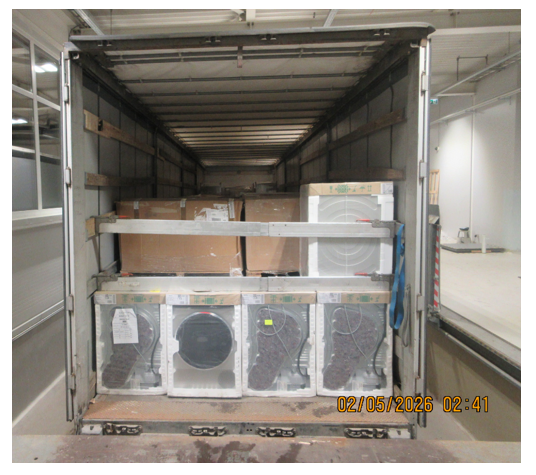
On 29 April, a suspected attempt to violate EU sanctions was prevented at the Terehova Customs Control Point. A freight vehicle operated by a carrier registered in Lithuania arrived heading towards Russia, and the driver submitted documents for customs control concerning goods (tumble dryers and their accessories) declared for export to Mongolia. A German company was indicated as the exporter in the customs declaration.

During the inspection, a second set of documents was found containing different information, including the recipient of the goods in Russia and a higher value of the goods. During an in-depth examination, torn documents bearing the carrier’s stamp were also found, and it was established that some of the declared goods were not actually present in the cargo compartment.

During the inspection, suspicions arose that the actual recipient of the goods was a Russian company, meaning that the EU export restrictions may apply to part of the consignment. The materials have been submitted for assessment of whether to initiate criminal proceedings.
 

About the Quarterly Publication

FIU Latvia publishes a quarterly summary of the most significant sanctions developments and statistics to provide the public with regular and transparent information on the application and compliance with sanctions in Latvia. The summary has been prepared using information available to FIU Latvia, as well as data provided by the Prosecutor General’s Office, the Court Administration, and the Customs Board of the State Revenue Service.
Other news
19.11.2026 14:20
Latvia’s sanctions implementation: Key developments and results in Q3 2026
In the third quarter of 2026, Latvia initiated 28 new criminal proceedings for violations of international sanctions, while the National Customs Board of the State Revenue Service (SRS) prevented 298 potential sanctions violations. The Financial Intelligence Unit of Latvia (FIU Latvia) received 419 reports of suspicious transactions or activities potentially linked to sanctions violations or attempted violations. Meanwhile, the European Union (EU) expanded its sanctions against Russia, and the Court of Justice of the European Union (CJEU) provided important clarification on the concept of control exercised by sanctioned persons over companies. SUMMARY The Council of the EU has adopted the 21st package of sanctions against Russia. In its judgment, the CJEU clarifies that control may also be informal and may exist without any legal link or shareholding. 28 new criminal proceedings have been initiated in Latvia for violations of international sanctions. In the third quarter, FIU Latvia received 419 suspicious transaction reports indicating suspected sanctions violations or attempted violations. Latvian courts concluded three criminal cases concerning sanctions violations, imposing fines and prison sentences. The Customs Board of the State Revenue Service (SRS) initiated 38 administrative offence proceedings. FIU Latvia has redesigned its sanctions website, improving both its appearance and functionality. Strengthening sanctions On 23 July, the Council of the European Union adopted the 21st package of sanctions against Russia, adding 48 natural persons and 168 legal persons to the European Union (EU) sanctions list, including several Russian oligarchs, banks, and companies in the military, oil and mining sectors. The main objective of this package is to intensify measures targeting Russia’s energy sector, financial system and crypto-asset sector, and to limit the so-called “shadow fleet”. The EU has also expanded restrictions on imports of goods that generate significant revenues for Russia, including ores and metal compounds, unwrought zinc, vehicle bodies and spare parts, and other goods. Export restrictions have also been extended to technologies and components that may be used for military purposes, including nickel powders, metals and certain alloys. In view of Belarus’s involvement in Russia’s war against Ukraine, new restrictive measures have also been imposed on Belarus. The list of goods subject to sanctions has been expanded to include materials and technologies that could contribute to Belarus’s military and technological enhancement, and four additional Belarusian companies have been made subject to EU sanctions. A significant CJEU judgment on sanctions On 3 September, the CJEU delivered its judgment in Inter Rao Lietuva (C-147/25), examining the practice of Lithuania’s Financial Crime Investigation Service (FNTT) of including, in its published list, companies that are not themselves listed by the EU but are owned or controlled by listed persons. The CJEU confirmed that such action by a national authority is permissible. The judgment is also significant because it clarifies the concept of control and the evidence required to establish it. The CJEU held that control may also be informal and may exist without any legal link or shareholding: a person exercising control may be neither an owner nor a company officer, yet may in practice be able to influence the company’s decisions. In such cases, control may be established not only by direct evidence but also by a sufficiently specific, precise and consistent set of indicia that demonstrate control by a listed person. A general assertion that Russia’s regime is authoritarian and that its President has virtually unlimited power over State-owned companies does not establish control. However, that circumstance may be taken into account as a contextual factor when assessing the evidence. FIU Latvia notes that its guidelines “Assessment of Control of Designated Public Officials” were updated in the preceding quarter of this year. These guidelines explain how to assess control where a designated public official may exercise control over a legal person, public authority or State-owned company that is not itself listed. FIU Latvia updates In the third quarter, FIU Latvia received 419 suspicious transaction reports indicating suspected sanctions violations or attempted violations. As in previous quarters, the reports mainly concerned the sale, supply, transfer or export of goods subject to sanctions to persons in Russia via third countries; the provision of prohibited services to legal persons established in Russia; the holding of accounts with credit institutions subject to sanctions; and the export of cash, namely euro-denominated banknotes, to Russia. A total of 80 analytical reports concerning potential sanctions violations were submitted to law enforcement authorities and other institutions. FIU Latvia continues to update the “Frequently Asked Questions” (FAQ) section of its website on sanctions implementation, clarifying existing guidance and adding new information. FIU Latvia has also prepared several explanations and answers to questions concerning the closure of the MERE retail chain in Latvia in compliance with EU sanctions restrictions, as well as guidance on how to check whether goods may be sold, supplied, transferred or exported to Russia or Belarus. In July, FIU Latvia’s sanctions website was redesigned to provide easier access to up-to-date information, guidance and practical tools on sanctions. The sanctions search tool has been enhanced, the information structure improved, and an option to subscribe to news by email introduced. Content is now available in both Latvian and English. At the end of the third quarter of 2026, the following assets owned or controlled by listed persons were frozen in Latvian financial institutions and State registers: funds – EUR 210.05 million;real estate – 110;vehicles – 66;trade marks – 13;tractors/self-propelled machinery – 11;watercraft – 1;herd – 1. The list of sanctioned persons whose assets are frozen in Latvia is available here. In September, FIU Latvia published the new National ML/TF/PF Risk Assessment for the period 2023–2025 (NRA). In the area of sanctions, it concludes that the threat of sanctions violations in Latvia remains high, while national capacity to identify and mitigate that threat has also increased. In Latvian Courts In the third quarter of 2026, Latvian courts delivered four judgments in criminal cases concerning sanctions violations. The judgments in three of these cases have become final. In one case, a natural person was fined more than EUR 14,000. In another, a natural person was fined EUR 39,000, while a monetary fine in amount of EUR 46,000 was imposed on a legal person. In the third case, three natural persons were sentenced to terms of imprisonment ranging from four months and 12 days to six months and three days, together with three years of probation supervision. In that criminal case, on 23 September 2026, Riga City Court convicted three persons under the plea agreement procedure of violating EU sanctions with the aim of helping Russia undermine Ukraine’s territorial integrity and independence. The convicted persons were members of an organised group that, in 2024, purchased goods suitable for military use and secretly delivered them, through carriers, to persons in Russia linked to the Russian armed forces. The members of the group knew that the goods were intended for use in Russia’s military attack on Ukraine. These were mainly satellite internet connectivity devices, the sale of which to Russia is prohibited, as well as ballistic weather meters and other prohibited goods. Equipment was handed over to carriers for delivery to Luhansk, which is controlled by the Russian armed forces. Meanwhile, the prosecution of the group's organiser is ongoing in a separate criminal proceeding. In another criminal case, the judgment had not yet entered into force by the end of the quarter. Criminal Proceedings Statistics in Latvia In the third quarter of 2026: 28 new criminal proceedings were initiated for sanctions violations;criminal prosecution was initiated in two criminal proceedings;charges were brought against five natural persons;criminal proceedings against legal persons;four criminal cases were referred to court;one set of criminal proceedings was concluded by a prosecutor’s penal order. In the proceedings concluded by a prosecutor’s penal order, a natural person was fined EUR 11,700. In the proceedings concluded by a prosecutor’s penal order, a Latvian citizen admitted to violating EU sanctions. The person was the sole owner and general director of an IT company registered in Russia and continued to ensure the company's operations, including the provision of prohibited IT consultancy, technical testing, and analysis services to Russian legal entities. A fine of EUR 11,700 was imposed, and EUR 6,710 was confiscated as proceeds of crime. Highlights from the Customs Board In the third quarter of 2026, the Customs Board of the SRS initiated 38 administrative offence proceedings concerning sanctions violations. To prevent the movement of sanctioned goods across the EU external border, the Customs Board refused to apply the declared customs procedures to 137 consignments in the third quarter of 2026. This prevented 123 consignments of goods subject to sanctions from leaving the EU and 14 consignments from entering Latvia from Russia and Belarus. Most frequently, exports from the EU were denied for electrical equipment and electronic goods, various machinery and their spare parts, as well as vehicles, trailers, and automotive spare parts. Cargo exports were primarily rejected because the requested documents or information were not submitted, the goods were subject to sanctions, an incorrect EU Combined Nomenclature (CN) code was indicated, or the respective goods are prohibited from transiting through Russia and Belarus. In several cases, a risk was also identified that vehicles or other goods would not reach the third country indicated in the declaration, as previous deliveries had not taken place or additional inspections revealed that the vehicles had been registered in Russia. During inspections of vehicles entering the EU, the import of wood and wood products, petroleum products, scrap metal, vehicle spare parts, as well as electrical and electronic goods was most frequently denied. The main reasons for rejection were that the goods were subject to sanctions, had a questionable or falsely declared origin, or that the requested origin and transaction documents were not submitted. In several cases, undeclared goods subject to sanctions were also found concealed among other cargo. In addition, during the third quarter of this year, 91 cases were identified involving attempts to export cash from the EU in violation of sanctions prohibitions. As a result of postal consignment controls, 12 of violations were prevented, while 58 cases violations by natural persons were identified involving attempts to move sanctioned goods across the border. Overall, in the third quarter of this year, customs controls carried out by the Customs Board of the SRS prevented 298 possible violations of EU sanctions against Russia and Belarus. Since September 2026, controls on wheat imported from Russia have been intensified to prevent products originating in the territories of Ukraine occupied by Russia from entering Latvia. Example of a sanctions violation involving a steam bath On 11 September 2026, a suspected attempt to violate EU sanctions was prevented at the Terehova Customs Control Point. A freight vehicle operated by a carrier registered in Lithuania arrived heading towards Russia. The consignor was a German company and the consignee a Russian company. The consignment consisted of a polymer steam bath kit, packed in disassembled form, and a heated bench. An in-depth customs inspection established that the goods were intended for household use and had been declared under an incorrect CN code. The consignment is covered by EU export prohibitions because the goods are classified as luxury goods whose export to Russia or for use in Russia is prohibited. The Tax and Customs Police initiated criminal proceedings in connection with the case. FIU Latvia publishes a quarterly summary of the most significant sanctions developments and statistics to provide the public with regular and transparent information on the implementation of and compliance with sanctions in Latvia. The summary has been prepared using information available to FIU Latvia, as well as data provided by the Prosecutor General’s Office, the Court Administration, and the Customs Board of the State Revenue Service. FIU Latvia is an independent authority responsible for preventing money laundering and terrorist financing, implementing sanctions, protecting the Latvian financial system from misuse, and cooperating with international partners. Iveta Locāne FIU Latvia’s Head of Communication Division prese@fid.gov.lv
Finanšu izlūkošanas dienesta VIII ikgadējā starptautiskā sankciju konference “Sankciju ietekme: graut Krievijas kara spējas” Rīgā, 2026. gada 12. novembrī.
16.11.2026 13:41
FIU Latvia: Coordinated action across EU Member States is key to strengthening sanctions against Russia
More than four years into Russia’s aggression against Ukraine, maintaining and strengthening the impact of sanctions on Russia remains a key priority for Latvia’s and Europe’s security. On 12 November 2026, the Financial Intelligence Unit of Latvia (FIU Latvia) brought together leading sanctions experts and decision-makers in Riga for its eighth annual international sanctions conference. Participants shared experiences and insights on sanctions effectiveness and enforcement, their role in weakening Russia’s war capabilities, and the importance of strengthening border security and resilience. The conference, “Sanctions Work: Degrading Russia’s War Machine”, brought together around 140 experts from 24 countries, including speakers and participants from the United Kingdom, Canada, Ukraine, Germany, France, Belgium, Sweden, Poland and other countries. “How much more money, technology and equipment would Russia have without restrictions that have been made? This is the question we must ask ourselves when assessing the impact of sanctions. More than four and a half years after Russia launched its full-scale invasion of Ukraine, the aggression continues. Sanctions restrict Russia’s access to finance, technology and goods, and reduce the revenues funding the war. Our task is to make that pressure stronger. For Latvia, sanctions have been, and remain, a matter of national security. Latvia’s eastern border is also an external border of the European Union and NATO. Our common security is a shared responsibility. Russia continues to seek new ways around sanctions. We must respond by identifying new routes of circumvention, sharing information promptly and applying restrictions consistently across borders. No institution, and no country, should or can do this work alone. Each sees a different part of the picture. Bringing that knowledge together helps us identify risks and act on them,” said Toms Platacis, Head of FIU Latvia, in his opening remarks at the conference. “Latvia’s geographical location and its borders with Russia and Belarus shape our priorities in addressing sanctions circumvention risks. Particular attention must be paid to export controls, as the recent National Risk Assessment shows that approximately two-thirds of potential sanctions violations identified by customs authorities involve exports to third countries rather than directly to Russia or Belarus. This highlights the significant risk of goods being diverted to Russia through intermediary countries. We therefore work closely with companies exporting high-risk goods and strengthen information sharing with other public authorities and the financial sector. Suspicious transaction reports submitted by banks are particularly important in helping us identify potential sanctions circumvention schemes at an early stage,” emphasises Marta Tilhena, Head of the Sanctions Implementation Division at FIU Latvia.“We have already seen unjustified and premature sanctions relief for Russia, even though it pretends to make “progress” in peace negotiations while destroying Ukraine’s energy and civilian infrastructure with renewed intensity. Meanwhile, the war in the Middle East has bought Russia additional time through windfall energy revenues. But these revenues are nowhere near enough to resolve the structural problems that have accumulated over more than four years of full-scale invasion and sanctions. As the sanctions coalition we must find ways to use economic pressure to finally bring Russia to the negotiating table ready to engage seriously. We have the tools,” explains Yuliia Pavytska, Head of the Sanctions Hub of Excellence at the KSE Institute (Kyiv School of Economics).   Sanctions as a tool for Latvia’s and Europe’s shared security Sanctions restrict Russia’s access to the financing, technology and goods needed to sustain its war. For Latvia, situated on the external border of the EU and NATO, sanctions implementation is a matter of security for the wider region. FIU Latvia plays a key role in this process. Since April 2024, Latvia has centralised responsibility for sanctions implementation within a single institution that combines financial intelligence, sanctions expertise and support for the public and private sectors, helping ensure effective sanctions implementation. Cooperation between EU Member States, competent authorities and the private sector is essential to translating restrictions into tangible results.   European Court of Auditors: Sanctions have had a significant impact, but more can be done The latest report by the European Court of Auditors confirms that EU sanctions have significantly affected trade with Russia, including bringing direct exports of high-priority and dual-use goods to a near halt. The report highlights Latvia as an example of good practice, while also identifying areas for improvement, including stronger coordination between Member States, more consistent customs controls, better information sharing and more effective assessment of the impact of sanctions.   Better risk identification and prevention of sanctions circumvention A recurring message throughout the conference discussions was that the effectiveness of sanctions should not be measured by the number of restrictions adopted or sanctions packages introduced, but by their actual impact on Russia’s ability to finance its war, obtain critical technologies and sustain military production. The conference organised by FIU Latvia reinforced the importance of international cooperation, financial intelligence and practical solutions in further strengthening the impact of sanctions and safeguarding the shared security of Latvia and Europe. Conference recording in English    Conference recording in Latvian:  Photos of the conference: https://flic.kr/ps/47nJko  Presentations: Mihails Kozlovs “The Effectiveness of Implementation of EU Trade Sanctions: Report by the European Court of Auditors” Marta Tilhena “Facilitating Sanctions Implementation by the National Competent Authority” Chloe Cina and Dara Fernandez “Case Study” Gonzalo Saiz Erasquin “The Shadow Crypto Economy Feeding Russia’s War Machine” Tom Robinson “A7: Crypto-Assisted Sanctions Evasion” Mark Handley “The Changing Face of Enforcement of EU Sanctions in 2026” Vicky Edgecombe “Overview of Canada's new compliance program for export controls and sanctions” OTSI “Sanctions End-Use Controls” Yuliia Pavytska “Stepping Up Sanctions Pressure on Russia in a Challenging Geopolitical Environment”   FIU Latvia is an independent authority responsible for preventing money laundering and terrorist financing, implementing sanctions, protecting the Latvian financial system from misuse, and cooperating with international partners. Iveta LocāneFIU Latvia’sHead of Communication Divisionprese@fid.gov.lv
11.11.2026 11:16
Sanctions Work: Degrading Russia’s War Machine - international conference livestreamed on 12 November
The effectiveness of European Union (EU) trade sanctions, Common High Priority (CHP) items and export controls, the role of crypto-assets in sanctions circumvention, sanctions enforcement, and the impact of sanctions on Russia’s economy will be the key topics of the VIII Annual sanctions conference, organised by the Financial Intelligence Unit of Latvia (FIU Latvia). The conference will take place in Riga on Thursday, 12 November 2026, and will be available to watch online in both English and Latvian. The conference will be opened by Toms Platacis, Head of FIU Latvia, followed by Vladyslav Vlasiuk, Advisor-Commissioner of the President of Ukraine for Sanctions Policy, who will share his insights on the role of sanctions in constraining Russia’s ability to wage war. The conference will be moderated by Paulis Iļjenkovs, Deputy Head of FIU Latvia, who will also deliver the closing remarks, highlighting key takeaways on sanctions implementation and the main insights shared throughout the day. The conference in Riga will bring together around 140 participants, including attendees and speakers, from 24 countries, including the United Kingdom (UK), Canada, Ukraine, Germany, France, Belgium, Sweden, Poland and others. “Every sanctions-related requirement serves a clear purpose: to reduce Russia’s ability to continue its war. As the central authority responsible for sanctions implementation, FIU Latvia helps foster a common understanding and coordinated action to ensure this purpose is reflected in day-to-day decisions,” emphasises Marta Tilhena, Head of the Sanctions Implementation Division at FIU Latvia, who will deliver a presentation on the role of the national competent authority in ensuring effective sanctions implementation. Mihails Kozlovs, Member of the European Court of Auditors, will present the latest findings on the effectiveness of EU trade sanctions. The discussion on the report’s findings, recommendations and way forward will also feature Timothée Truelle, Head of the EU External Relations Division at the French Ministry for Europe and Foreign Affairs, and Raimonds Zukuls, Director of the National Customs Board and Deputy Director General for Customs Issues at the State Revenue Service of Latvia. International experts will discuss export controls and the role of the private sector in sanctions implementation, including Anu Mathur Boyd, Head of Sanctions and Export Controls at Maersk, alongside sanctions experts Chloe Cina and Dara Fernandez. The role of crypto-assets in sanctions circumvention will be examined by Gonzalo Saiz Erasquin, Research Fellow at the Centre for Finance and Security at RUSI, and Tom Robinson, Founder and Chief Scientist at Elliptic, Associate Fellow at RUSI. International experience in combating sanctions violations and export controls will be shared by Vicky Edgecombe, Director at Global Affairs Canada, Mark Handley, Partner at Duane Morris, and representative from the Office of Trade Sanctions Implementation, UK Department for Business, Innovation, Science and Trade. Towards the end of the conference, Yuliia Pavytska, Head of the Sanctions Hub of Excellence at the Kyiv School of Economics Institute, will present findings on the economic impact of sanctions on Russia and discuss ways to increase sanctions pressure. Recording in Latvian:   Recording in English:     Fotogrāfijas no konferences: https://flic.kr/ps/47nJko  FIU Latvia is an independent authority responsible for preventing money laundering and terrorist financing, implementing sanctions, protecting the Latvian financial system from misuse, and cooperating with international partners.