breadcrumb arrow breadcrumb arrow
News

News

04.08.2026 14:15
Key Sanctions Highlights in Q2 2026
SUMMARY The European Union (EU) has expanded its sanctions lists in response to Russia's war against Ukraine. It has imposed sanctions on several individuals and entities involved in the unlawful deportation and forced transfer of Ukrainian children to Russia.The Court of Justice of the European Union (CJEU) has clarified that assets placed in a trust must be frozen if the sanctioned person retains the ability to control or benefit from those assets.24 new criminal proceedings have been initiated in Latvia for violations of international sanctions.During Q2, the Financial Intelligence Unit of Latvia (FIU Latvia) received 359 suspicious transaction reports regarding suspected sanctions violations or attempted sanctions violations.Latvian courts concluded four criminal cases involving sanctions violations, imposing fines and ordering liquidation of a legal entity.The Customs Board of the State Revenue Service (SRS) initiated 52 administrative offence proceedings.FIU Latvia has published updated guidelines "Assessment of control of designated public officials".   Strengthening of Sanctions On 11 May, the Council of the EU adopted sanctions against an additional 16 individuals and seven entities involved in the unlawful deportation and forced transfer of Ukrainian children to Russia. According to the EU, the sanctions target persons and institutions involved in the systematic, unlawful deportation and forced transfer of Ukrainian children, the so-called militarised “re-education”, and unlawful adoption practices. The sanctions apply to Russian officials and politicians, children's centres, youth organisations, and other entities facilitating the integration of Ukrainian children into the Russian system. On 15 June, the Council of the EU adopted a decision to expand the EU's sanctions lists against Russia. The changes include additions to the lists of natural and legal persons subject to targeted financial sanctions in connection with Russia’s illegal war in Ukraine, Russia’s hybrid threat activities, and human rights violations. Notably, these additions to the sanctions list were adopted outside the EU’s broader sanctions package.   Key Judgments of the Court of Justice of the European Union On 21 May, the CJEU delivered a judgment interpreting the obligation to freeze assets under targeted financial sanctions in relation to funds and economic resources transferred by a sanctioned person into a trust. The CJEU ruled that assets transferred into a trust may be regarded as owned or controlled by the sanctioned person ns if that person retains powers enabling them to use, benefit from, dispose of, or otherwise exercise influence over those assets, including the ability to influence decisions made by the trustee in relation to them. On 11 June, the CJEU dismissed the appeal filed by Russia's National Settlement Depository (NSD) seeking its removal from the EU sanctions list. The CJEU held that an entity's significant role in Russia's financial system and its contribution to the functioning of the Russian state's financial system may constitute sufficient grounds for its inclusion on the EU sanctions list. The Court further clarified that it is not necessary to demonstrate that the entity directly financed Russia's military aggression or specific actions aimed at destabilising Ukraine. Rather, it is sufficient to establish that the entity provides material or financial support to the Russian Government or plays a significant role in the relevant sector. As a result, the CJEU dismissed the appeal and upheld the General Court's judgment confirming that the inclusion of Russia's NSD on the EU sanctions list was justified and should be maintained.   FIU Key Developments During Q2, FIU Latvia received 359 suspicious transaction reports indicating suspected sanctions violations or attempted sanctions violations. As in Q1, the most common cases in Q2 involved the potential transfer of sanctioned goods to Russia through third countries, the provision of prohibited services to legal entities established in Russia, accounts held with banks included on sanctions lists, and the transportation of cash to Russia. A total of 84 analytical reports concerning potential sanctions violations were submitted to law enforcement authorities and other institutions. FIU Latvia continues to update the “Frequently Asked Questions” (FAQ) section of its website regarding implementation of sanctions by clarifying existing explanations and adding new information. The updated FAQ section provides explanations on making payments after the end of transitional periods, the application of import bans and transit through the EU, the application of General License, the interpretation of contracts concluded before the imposition of sanctions, trade in goods imported before the imposition of sanctions, as well as restrictions on the provision of management services to legal entities registered in Russia and Belarus. FIU Latvia has published updated guidelines "Assessment of control of designated public officials". The guidelines have been supplemented in accordance with the definitions included in EU sanctions legislation of “owning a legal person, entity or body” and “controlling a legal person, entity or body”. Although EU institutions had previously provided guidance on the criteria to be considered when assessing ownership and control for the purposes of applying sanctions, these criteria have now been legally established in Regulation (EU) No 269/2014. FIU Latvia’s approach to the assessment of control remains unchanged. At the end of Q2 of 2026, the following assets owned or controlled by persons included on sanctions lists were frozen in Latvian financial institutions and state registers: Funds – EUR 151.9 millionReal estate – 103Vehicles – 66Tractors/self-propelled machinery – 11Watercraft – 1Herd – 1Trademarks – 12 The list of sanctioned persons whose assets have been frozen in Latvia is available here. Criminal Proceedings Statistics in Latvia During Q2 of 2026: 24 new criminal proceedings were initiated for international sanctions violations;criminal prosecution was initiated in seven criminal proceedings;charges were brought against nine natural persons;five criminal proceedings were referred to court.   In Latvian Courts During Q2 of 2026, Latvian courts examined four criminal cases concerning sanctions violations. Judgments in two of these cases have entered into force. In one case, a fine of EUR 10’100 was imposed on a natural person, while two legal persons were subject to coercive measures – one was ordered to be liquidated, and the other was ordered to pay EUR 17’900. In the second case, a decision to terminate criminal proceedings entered into force based on amendments to paragraph one of Section 84 of the Criminal Law, which entered into force on 10 June 2025 and provide for criminal liability in cases where the value of goods is not less than EUR 10’000. In two further cases, the judgments had not yet entered into force by the end of the quarter –one natural person was subject to probation supervision for four years, while the other was sentenced to community service.   Highlights from the Customs Board During Q2 of 2026, the Customs Board of the SRS initiated 52 administrative offence proceedings concerning sanctions violations. To prevent the movement of sanctioned goods across the EU external border, during the second quarter of 2026, the Customs Board refused to apply the declared customs procedures to 185 consignments. As a result, the export of 157 consignments of sanctioned goods from the EU and the import of 28 consignments into Latvia from Russia and Belarus were prevented. Most frequently, the refused exports concerned consignments containing spare parts for various devices and machinery, electrical equipment and parts thereof, as well as vehicle spare parts. Several cases were also prevented where attempts were made to export goods declared under an incorrect Combined Nomenclature (CN) code and whose supply to third countries is not possible because they are prohibited from being moved in transit through the territories of Russia and Belarus. Such goods included, for example, vehicle spare parts, iron or steel structures and parts thereof, as well as lubricants. In addition, during the second quarter of this year, 101 cases were identified involving attempts to export cash from the EU in violation of sanctions prohibitions. As a result of postal consignment controls, one violation was prevented, while in 51 cases violations by natural persons were identified involving attempts to move sanctioned goods across the border. Overall, during Q2 of this year, the Customs Board prevented 338 potential violations of EU sanctions against Russia and Belarus while carrying out customs control measures. From 25 to 29 May, a pilot mission of the European Union Customs Alliance for Borders (EUCAB) took place at the Terehova Customs Control Point in the field of customs officials’ mobility and exchange. Latvia is the first EU Member State where this new EUCAB initiative has been implemented in practice, ensuring the full organisational process and successful implementation of the mission at the Terehova Customs Control Point.   Example of a sanctions violation: use of a third country to deliver goods to Russia On 29 April, a suspected attempt to violate EU sanctions was prevented at the Terehova Customs Control Point. A freight vehicle operated by a carrier registered in Lithuania arrived heading towards Russia, and the driver submitted documents for customs control concerning goods (tumble dryers and their accessories) declared for export to Mongolia. A German company was indicated as the exporter in the customs declaration. During the inspection, a second set of documents was found containing different information, including the recipient of the goods in Russia and a higher value of the goods. During an in-depth examination, torn documents bearing the carrier’s stamp were also found, and it was established that some of the declared goods were not actually present in the cargo compartment. During the inspection, suspicions arose that the actual recipient of the goods was a Russian company, meaning that the EU export restrictions may apply to part of the consignment. The materials have been submitted for assessment of whether to initiate criminal proceedings.   About the Quarterly Publication FIU Latvia publishes a quarterly summary of the most significant sanctions developments and statistics to provide the public with regular and transparent information on the application and compliance with sanctions in Latvia. The summary has been prepared using information available to FIU Latvia, as well as data provided by the Prosecutor General’s Office, the Court Administration, and the Customs Board of the State Revenue Service.
24.07.2026 09:00
The EU's 21st sanctions package will significantly impact Russia's energy and financial sectors
The European Union (EU) has reached an agreement on the 21st package of sanctions against Russia. The new sanctions package targets the country's energy sector, one of its most significant sources of revenue, and introduces additional restrictive measures against the financial sector. The objective of these sanctions is to further reduce Russia's ability to finance its military aggression against Ukraine. Key elements of the 21st sanctions package Targeted financial sanctions Annex I to Council Regulation (EU) No 269/2014 has been amended to include: 48 natural persons 168 legal entities Inclusion in Annex entails an obligation to freeze all funds and economic resources belonging to, owned, held, or controlled by these persons, entities, or bodies. In addition, it is prohibited to directly or indirectly make funds or economic resources available to or for the benefit of these persons, entities, or bodies. Energy sector More than 40 additional shadow fleet vessels listed Suspension of the amendment of the Russian crude oil price cap To reduce Russia's revenues from oil exports, the new sanctions package suspends the price cap adjustment mechanism until 14 July 2027, maintaining the oil price cap at its current level. The price cap is currently set at USD 44.10 per barrel. Under the previous EU sanctions framework, the price cap for Russian oil was subject to regular review based on the average global market price of oil. These amendments eliminate the risk that, due to geopolitical developments and sharp fluctuations in oil prices, the EU price cap applicable to Russian-origin crude oil and petroleum products could increase. This price cap determines the maximum price at which EU persons may provide technical assistance and other services related to the maritime transport of such oil and petroleum products. Ban on transactions with designated oil refineries, ports, locks and airports The 21st sanctions package adds one more third-country oil refinery to the list of designated entities. The refinery processes or blends petroleum products or mineral products of Russian origin. The list has also been expanded to include specific Russian ports, locks and airports with which transactions are prohibited. Financial sector Stricter restrictions on third-country crypto-asset service providers to prevent sanctions circumvention A transaction ban has already been imposed on engaging in any transactions with legal entities based outside the EU that provide crypto-asset services or payment services to persons who are included on sanctions lists or who otherwise significantly impede the achievement of the sanction’s objectives set forth in the regulations. In this list multiple financial institutions have been added, broadening the transaction ban. The 21st sanctions package introduces a new annex which may in the future include any legal entities from third countries that provide crypto-asset services and whose activities are used to circumvent EU sanctions or violate prohibitions established in the field of crypto-assets. This annex will include entities that have systematically and persistently failed to prevent the provision of crypto-asset services thereby frustrating the provisions of sanctions regulations. Although no persons have been listed in the annex at this stage, the introduction of this mechanism sends a clear signal to third-country crypto-asset service providers that they may become subject to EU sanctions if they are involved in transactions that violate the EU sanctions regime. Expanded list of credit institutions subject to the transaction ban The list of credit institutions subject to the transaction ban has been expanded by an additional 33 credit institutions. As a result, the total number of credit institutions with which transactions are prohibited now exceeds 100. One credit institution from Kyrgyzstan has been added to the list of third-country banks using the Central Bank of Russia's Financial Messaging System (SPFS). In addition, more than 20 financial institutions providing crypto-asset services that significantly undermine the objectives of the EU sanctions have been added to the list. It is now prohibited to engage in transactions or otherwise conduct business with these financial institutions. Other sectoral sanctions The EU expands sanctions against persons supporting Russia's defence and security sector The EU has imposed sanctions on 51 legal entities which are a part of Russia’s military and industrial complex or supporting it in its war of aggression against Ukraine, on whom and on which tighter export restrictions are imposed regarding dual-use goods and technology, as well as regarding goods and technology which might contribute to the technological enhancement of Russia’s defence and security sector.The list includes legal persons established both in Russia and in third countries. Expanded list of goods and technologies subject to export and transit restrictions By adopting the 21st sanctions package, the list to include goods and technologies that could contribute to the enhancement of Russia’s military and technological capabilities or the development of its defence and security sectors has been supplemented. The goods and technologies included on this list are not only subject to export ban to Russia, but it is also prohibited to transport the items in transit through Russian territory. The export ban will apply to certain aviation-related products intended for use in unmanned aerial vehicles (UAVs), jamming and interception systems, as well as launch systems. Sanctions against Belarus In view of Belarus's involvement in Russia's war against Ukraine, the EU has also adopted new restrictive measures against Belarus. Some of these measures have been aligned with the new restrictions imposed on Russia. The adopted measures include listing additional persons who contribute to enhancing the military and technological capabilities of Belarus or Russia. In addition, the export ban has been expanded to cover specific goods, including certain aviation-related products intended for use in unmanned aerial vehicles (UAVs). More information on the new sanctions package in the Official Journal of the EU. Since April 2024, FIU Latvia has been the national competent authority for sanctions implementation in Latvia, working with Latvian and international partners to strengthen the effectiveness of sanctions.
23.07.2026 16:00
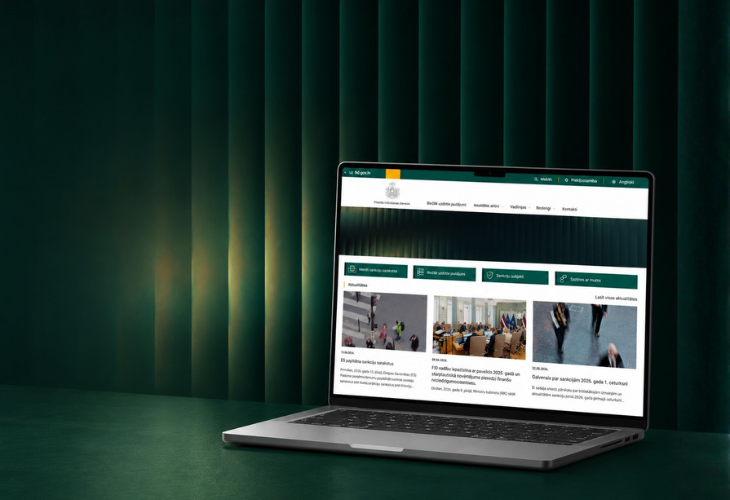
FIU Latvia improves access to sanctions information with redesigned website now available in English
The Financial Intelligence Unit of Latvia (FIU Latvia) has introduced a redesigned sanctions website, which is now available in both Latvian and English and offers improved functionality, an enhanced user experience, and easier access to up-to-date sanctions information. The website is designed to serve as a single, reliable and user-friendly source of information on the implementation of sanctions in Latvia, helping individuals, businesses and public authorities quickly access practical guidance, explanatory materials and other sanctions-related resources. The redesigned website features an enhanced sanctions search tool, including the ability to find sanctioned persons even when names differ in spelling, for example due to transliteration. It also enables users to upload an Excel template to screen up to 500 persons simultaneously and receive the results by e-mail. In addition, the website offers a modern and more user-friendly interface and a clearer information structure. The Frequently Asked Questions (FAQ) section is regularly updated to provide answers to the most common practical questions regarding the implementation of sanctions. To help users stay informed, a new "Receive news by email" feature has been introduced, allowing visitors to subscribe to notifications in two categories: sanctions-related news and updates to targeted financial sanctions lists. Notifications on sanctions list updates include the listing and delisting of persons and entities, as well as changes to their identification information under the United Nations, European Union and Latvian national sanctions lists. The website provides up-to-date information on sanctioned persons and entities, including those whose funds or economic resources (assets) have been frozen in Latvia. Users can also access legislation, guidelines, explanatory materials, and other information related to the implementation of sanctions. Access the redesigned website to stay informed about the latest sanctions developments: https://sankcijas.fid.gov.lv. Since April 2024, FIU Latvia has been the national competent authority for sanctions implementation in Latvia, working with Latvian and international partners to strengthen the effectiveness of sanctions.
06.07.2026 12:00
FIU Latvia publishes updated guidelines on the assessment of control of designated public officials
The Financial Intelligence Unit of Latvia (FIU Latvia) has updated its guidelines, "Assessment of control of designated public officials." The guidelines explain how to assess the control criterion in situations where control over a legal person, public authority, or state-owned enterprise that is not itself subject to sanctions may be exercised by a public official designated under financial sanctions. Targeted financial sanctions apply not only to persons directly designated in sanctions lists, but also to legal persons, entities or bodies that are owned or controlled by designated persons. Consequently, assessing the control criterion is one of the most complex aspects of implementing targeted financial sanctions in practice, and a consistent approach to such assessments is essential for ensuring the effective implementation of sanctions and legal certainty. Due to Latvia's geographical location and historical economic ties, persons in Latvia may encounter public authorities and state-owned enterprises of Russia and Belarus. Therefore, the purpose of the guidelines is to promote consistent sanctions implementation practices and legal certainty by explaining the FIU's approach to assessing control in situations where a designated public official may exercise it. The second updated version has been prepared to align the guidelines with amendments to Council Regulation (EU) No 269/2014, introducing definitions of "owning a legal person, entity or body" and "controlling a legal person, entity or body" in Article 1 of the Regulation. Although the institutions of the European Union had previously clarified the criteria to be considered when assessing ownership and control for sanctions purposes, these amendments harmonise and expressly incorporate those legal concepts into Regulation (EU) No 269/2014. Consequently, the FIU's approach to assessing control has not changed in substance. "Assessment of control of designated public officials." Since April 2024, FIU Latvia has been the national competent authority for sanctions implementation in Latvia, working with Latvian and international partners to strengthen the effectiveness of sanctions.
15.06.2026 11:29
EU updates sanctions lists
On 15 June 2026, the Council of the European Union (EU) adopted a decision to expand sanctions lists related to Russia by imposing restrictive measures on additional persons. The changes include additions to the lists of natural and legal persons subject to targeted financial sanctions in connection with Russia’s illegal war in Ukraine, Russia’s hybrid threat activities, and human rights violations. Persons included in the sanctions lists are subject to asset freezes, and EU citizens and companies are prohibited from making funds or economic resources available to them. Individuals are also subjected to travel restrictions, preventing them from entering or transiting through the territory of the EU. Notably, these additions to the sanctions list were adopted outside the EU’s broader sanctions package, signaling a more flexible and responsive approach to sanctions adoption. Learn more about the updated sanctions lists: https://eur-lex.europa.eu/legal-content/LV/TXT/?uri=OJ:L_202601361https://eur-lex.europa.eu/legal-content/LV/TXT/?uri=OJ:L_202601356https://eur-lex.europa.eu/legal-content/LV/TXT/?uri=OJ:L_202601362 Since April 2024, FIU Latvia has been the national competent authority for sanctions implementation in Latvia, working with Latvian and international partners to strengthen the effectiveness of sanctions.
22.05.2026 11:49
Key Sanctions Highlights in Q1 2026
SUMMARY EU is strengthening sanctions against Russia, including banning the import of petroleum products produced from Russian crude oil and approving a gradual phase-out of Russian natural gas.Krievijas dabasgāzes.EU is expanding sanctions lists in response to human rights violations and Russia’s destabilising activities.The Court of Justice of the European Union confirms broader application of sanctions to companies and prohibits sanctioned persons from participating in shareholders’ meetings.In Latvia, 24 new criminal proceedings have been initiated for violations of international sanctions.Latvian courts completed adjudication in 11 sanctions-related cases, with several resulting in fines and imprisonment.The Customs Board of the State Revenue Service initiated 29 administrative offence proceedings.Guidance on the application of sanctions has been updated. Strengthening of SanctionsOn 21 January, a ban entered into force in the European Union (EU) on the import of petroleum products manufactured from Russian crude oil.¹ Although the EU had already prohibited imports of Russian crude oil (except via pipelines), it had until now remained permissible to import petroleum products manufactured in third countries using Russian crude oil.On 26 January, a regulation was adopted approving the EU’s gradual phase-out of Russian natural gas.² The import ban entered into force on 18 March, while transitional periods for the fulfilment of existing contracts will remain in place until the end of 2027. Specific exemptions are also предусмотрены for landlocked countries.Although the 20th sanctions package was adopted on 23 April, during the first months of the year the EU expanded sanctions regimes targeting Russia’s “hybrid warfare”³ activities and human rights violations. On 23 February, the EU imposed sanctions on eight Russian individuals for serious human rights abuses and acts of repression. In addition, the sanctions list related to Russia’s destabilising activities was expanded by 10 individuals, primarily authors and distributors of Russian propaganda.Key Judgments of the Court of Justice of the European UnionOn 26 March, the Court of Justice of the European Union dismissed appeals submitted by five sanctioned individuals — Dmitry Alexandrovich Pumpyanskiy, Tigran Khudaverdyan, Viktor Filippovich Rashnikov, Dmitry Arkadievich Mazepin, and German Khan — who sought the annulment of sanctions imposed against them.⁵ The joined cases are particularly significant because the Court interpreted the criterion of an “influential businessperson” for inclusion on sanctions lists. The Court confirmed that a person may justifiably be sanctioned even without direct links to the Russian government if the individual is economically influential or operates in a sector constituting a substantial source of revenue for the Russian government.Additional important sanctions-related judgments were delivered on 12 March. The Court confirmed⁶ that the assets of a company owned or controlled by a sanctioned person may also be frozen even if the company itself is not listed under sanctions, provided that at least 50% of its shares are owned by a sanctioned individual.In another judgment,⁷ the Court ruled that persons included on sanctions lists are not permitted to participate in shareholders’ meetings or exercise voting rights therein.FIU Key DevelopmentsDuring the first quarter, the Financial Intelligence Unit of Latvia received 310 suspicious transaction reports indicating possible sanctions violations or attempted violations. Most reports concerned the possible shipment of prohibited goods to Russia through third countries, the provision of services to Russian companies, accounts held in sanctioned banks, and the transportation of cash to Russia. A total of 51 analytical reports relating to possible sanctions violations were forwarded to law enforcement and other authorities.On 20 February, the FIU adopted a new General Authorisation, expanding the categories of payments for which sanctioned persons no longer require separate FIU permission.The FIU also repeatedly updated the “Frequently Asked Questions” section of its website regarding sanctions implementation, clarifying existing guidance and adding new questions. New explanations were provided, for example, regarding the provision of services to Russian and Belarusian companies, the obligation to comply with EU sanctions in third countries, the holding of shares in Russia or Belarus, framework agreements, the transit of goods through the EU, and the FIU General Authorisation.By the end of the first quarter of 2026, the following assets owned or controlled by sanctioned persons had been frozen in Latvian financial institutions and state registers: funds — EUR 152.2 millionreal estate properties — 103vehicles — 66agricultural machinery — 11vessel — 1livestock herd — 1trademarks — 12 A list of sanctioned persons with frozen assets in Latvia is available here.Criminal Proceedings Statistics in LatviaDuring the first quarter of 2026:24 new criminal proceedings were initiated for violations of international sanctions;criminal prosecution was commenced in six criminal proceedings;charges were brought against seven natural persons;five criminal proceedings were referred to court;two criminal proceedings were completed through prosecutorial penalty orders.In one of the proceedings concluded through a prosecutorial penalty order, a natural person was fined EUR 9,360, while a legal entity was ordered to pay more than EUR 17,100. The case concerned an attempt to export sanctioned goods — primer products valued at EUR 67,800 — to Russia using falsified documents and falsely declaring Kazakhstan as the final destination. The goods had already been confiscated, sold, and the proceeds transferred to the state budget.In another criminal proceeding concluded through a prosecutorial penalty order, a Russian citizen holding a permanent residence permit in Latvia was placed under probation supervision for three years. In this case, the individual knowingly violated EU sanctions against the Russian Federation for financial gain by remotely working as a programmer (1C developer) for a Russia-registered company and thereby systematically providing prohibited IT consultancy services. Between 2022 and 2025, the individual received remuneration amounting to 5.89 million Russian roubles (approximately EUR 64,200). Part of this remuneration — nearly EUR 10,000 — was received through an account held with a sanctioned bank, thereby directly making funds available to a sanctioned legal entity.In Latvian CourtsDuring the first months of the year, Latvian courts completed adjudication in 11 criminal cases related to sanctions violations.In one case, a judgment entered into force imposing fines exceeding EUR 26,500 on two individuals. In two other cases, criminal proceedings were terminated after the court concluded that no criminal offence had occurred.A further six individuals were convicted in cases where judgments had not yet entered into force by the end of the quarter. In two cases, imprisonment sentences of 11 years⁸ and three years respectively were imposed. The largest fine imposed on a natural person amounted to EUR 31,200, while the largest monetary recovery ordered against a legal entity amounted to EUR 39,000.Customs Board TopicalitiesThe Customs Administration of the State Revenue Service of Latvia initiated 29 administrative offence proceedings related to sanctions violations.Overall, during the reporting period, 187 consignments were denied border crossing due to sanctions violations or suspicions of sanctions circumvention. Most rejected consignments concerned exports. The most frequently blocked exports included spare parts for various devices and machinery, electrical equipment and components, and vehicle spare parts. Imports from Russia and Belarus involving construction structures, timber, iron compounds, and furniture were also denied.In an additional 43 cases, attempts were identified to export cash denominated in official EU Member State currencies from the EU in violation of sanctions regulations. Postal controls prevented 31 violations, while 42 cases involved individuals attempting to transport sanctioned goods across the border.Example of a Sanctions ViolationOn 23 January 2026, at the Pāternieki Customs Control Point, customs officials identified an attempt to transport engines to Belarus. Although the declared recipient was located in Kazakhstan, the engines in question were also prohibited from transit through Russia and Belarus. The total value of the goods amounted to EUR 102,000. Criminal proceedings were initiated in connection with the case. Photos by Customs Board About the Quarterly PublicationThe Financial Intelligence Unit of Latvia publishes quarterly summaries of key sanctions-related developments and statistics in order to provide the public with regular and transparent information regarding sanctions updates and their enforcement in Latvia. The publication is based on information available to the FIU, as well as data provided by the Prosecutor General’s Office, the Court Administration, and the Customs Administration of the State Revenue Service. 1The prohibition is set out in Article 3m of Council of the European Union Council Regulation (EU) No 833/2014: https://eur-lex.europa.eu/legal-content/EN/AUTO/?uri=celex:32025R1494.  2https://eur-lex.europa.eu/legal-content/EN/TXT/?uri=OJ:L_202600261. 3https://eur-lex.europa.eu/legal-content/EN/TXT/?uri=CELEX%3A02024R2642-20260316. 4https://eur-lex.europa.eu/legal-content/EN/TXT/?uri=CELEX%3A02024R1485-20260223. 5Judgment in joined cases C-696/23 P, C-704/23 P, C-711/23 P, C-35/24 P and C-111/24 P: https://eur-lex.europa.eu/legal-content/LV/TXT/HTML/?uri=CELEX:62023CJ0696. 6 Judgment in case C-84/24: https://eur-lex.europa.eu/legal-content/LV/TXT/HTML/?uri=CELEX:62024CJ0084. 7 Judgment in case C‑465/24: https://eur-lex.europa.eu/legal-content/LV/TXT/HTML/?uri=CELEX:62024CJ0465. 8 In the case, violation of sanctions was one of the criminal offences with which the person had been charged. The term of imprisonment was reduced to 9 years, 8 months and 29 days, applying Section 52 of the Criminal Law.

22.05.2026 11:24
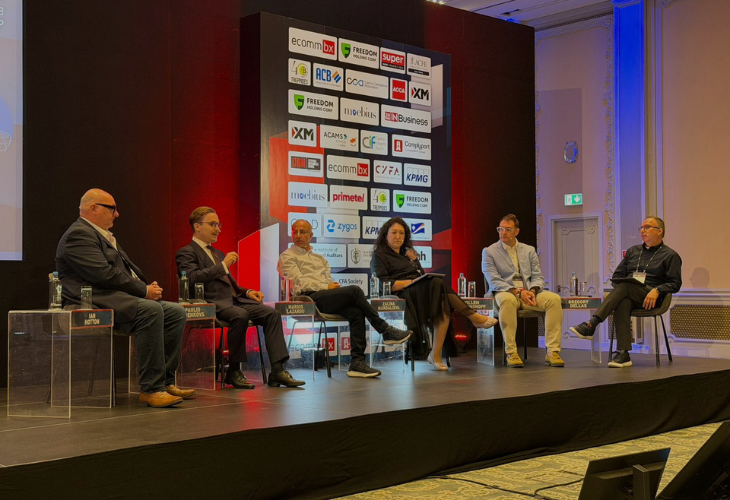
The Financial Intelligence Unit of Latvia Highlights the Importance of Cooperation in Sanctions Implementation at an International Forum
On Wednesday, 20th of May 2026, Financial Intelligence Unit of Latvia Deputy Head for Sanctions Paulis Iļjenkovs participated in the 12th International Compliance Forum in Cyprus, speaking in two expert panel discussions. In one of the discussions on sanctions-related issues, experts addressed the growing complexity of sanctions implementation, including the risks of sanctions circumvention, the importance of international cooperation, and the crucial role of timely information exchange between the public and private sectors. During the discussion, it was emphasized that identifying cases of sanctions circumvention does not indicate a lack of sanctions effectiveness; rather, it demonstrates active sanctions implementation, monitoring, and coordinated action by competent authorities and international partners. Since April 2024, the Financial Intelligence Unit of Latvia has been the national competent authority for sanctions enforcement matters in Latvia. The Service ensures the implementation of sanctions in Latvia and cooperates with Latvian and international partners to promote the effectiveness of sanctions. Sanctions lists, explanatory materials, and other useful information are available on the FIU’s website.
18.05.2026 11:32
EU sanctions additional 16 individuals and seven entities over deportation of Ukrainian children
On 11 May 2026, the Council of the European Union (EU) adopted sanctions against additional 16 individuals and seven entities involved in the unlawful deportation and forced transfer of Ukrainian children to Russia.According to the EU, the sanctions target persons and institutions involved in the systematic, unlawful deportation, forced transfer of Ukrainian children, the so-called militarised “re-education”, and unlawful adoption practices. Those listed include Russian officials and politicians, children’s centres, youth organisations, and other structures facilitating the integration of Ukrainian children into the Russian system. According to information provided by the EU, since the beginning of Russia’s full-scale invasion of Ukraine, Russia has deported and forcibly transferred nearly 20,500 Ukrainian children. These actions constitute serious violations of international law and children’s fundamental rights, aimed at erasing Ukrainian identity and threatening the preservation of future generations. Those listed today are subject to an asset freeze, and EU citizens and companies are forbidden from making funds and economic resources available to them. Natural persons are additionally subject to a travel ban that prohibits them from entering or transiting through EU territories.Notably, these additions to the sanctions list were adopted outside the EU’s broader sanctions package, signalling a more flexible and responsive approach to sanctions adoption. Learn more about the updated sanctions list.
07.05.2026 11:21
FIU Participates in European Commission High-Level Discussions on Strengthening Sanctions and Preventing Circumvention Risks
On 29th of April, representatives of the Financial Intelligence Unit of Latvia participated in the ninth high-level meeting organised by the European Commission on the implementation of European Union (EU) restrictive measures. During the meeting, representatives of EU Member States, the European Commission, the European External Action Service and partner countries discussed the effectiveness of sanctions regimes, current trends in sanctions violations, as well as opportunities to strengthen a unified approach to sanctions implementation and prevent sanctions breaches. The meeting was chaired by Commissioner for Financial Services and the Savings and Investments Union Maria Luís Albuquerque. “Such formats of international cooperation are important for building a common understanding of sanctions risks, promoting information exchange, and strengthening practical cooperation among EU Member States and international partners. Effective sanctions implementation is an essential prerequisite for ensuring European security and the rule of law,” emphasised Marta Tilhena. Particular attention was devoted to the recently adopted 20th sanctions package, including the first-ever application of the EU anti-circumvention instrument. In response to increasing trade flows of high-priority goods to certain third countries and potential sanctions circumvention risks, the EU introduced a prohibition on the export of specific goods to the Kyrgyz Republic. The measures aim to reduce the risk that such goods could be re-exported to Russia and used for the needs of its military-industrial complex. The meeting also addressed issues related to restrictions on Russian energy exports, the activities of the so-called “shadow fleet,” the use of alternative payment networks in third countries, and the impact of sanctions on Russia’s ability to finance warfare. Participants discussed the latest trends and typologies of sanctions violations, as well as effective solutions for preventing and investigating sanctions breaches. At the same time, the importance of the EU’s international dialogue with third countries was highlighted. Discussions included examples where financial institutions and supervisory authorities in third countries introduced significant improvements in sanctions risk management following the imposition of EU sanctions. In certain cases, after assessing the effectiveness and sustainability of these improvements, financial institutions were subsequently removed from EU sanctions lists. Member States also shared practical experience in sanctions enforcement and investigations of sanctions violations, including the detention and seizure of “shadow fleet” vessels, as well as criminal proceedings in cases where sanctioned goods had been attempted to be delivered to Russia through third countries. Following the high-level meeting, the Sanctions Coordinators Forum took place under the leadership of EU Sanctions Envoy David O’Sullivan. Representatives from Ukraine, the United Kingdom, the United States and other partner countries also participated in the forum, discussing the impact of sanctions and strengthening future international cooperation. During the meetings, the importance of intelligence-sharing and interinstitutional cooperation in effective sanctions implementation was also emphasised, alongside the need to continue close cooperation with third countries and the private sector in sanctions risk management. Since April 2024, the Financial Intelligence Unit of Latvia has been the national competent authority for sanctions implementation.