breadcrumb arrow breadcrumb arrow
Read news
Key Sanctions Highlights in Q1 2026
22.05.2026.

SUMMARY

  • EU is strengthening sanctions against Russia, including banning the import of petroleum products produced from Russian crude oil and approving a gradual phase-out of Russian natural gas.Krievijas dabasgāzes.
  • EU is expanding sanctions lists in response to human rights violations and Russia’s destabilising activities.
  • The Court of Justice of the European Union confirms broader application of sanctions to companies and prohibits sanctioned persons from participating in shareholders’ meetings.
  • In Latvia, 24 new criminal proceedings have been initiated for violations of international sanctions.
  • Latvian courts completed adjudication in 11 sanctions-related cases, with several resulting in fines and imprisonment.
  • The Customs Board of the State Revenue Service initiated 29 administrative offence proceedings.
  • Guidance on the application of sanctions has been updated.

Strengthening of Sanctions

On 21 January, a ban entered into force in the European Union (EU) on the import of petroleum products manufactured from Russian crude oil.¹ Although the EU had already prohibited imports of Russian crude oil (except via pipelines), it had until now remained permissible to import petroleum products manufactured in third countries using Russian crude oil.

On 26 January, a regulation was adopted approving the EU’s gradual phase-out of Russian natural gas.² The import ban entered into force on 18 March, while transitional periods for the fulfilment of existing contracts will remain in place until the end of 2027. Specific exemptions are also предусмотрены for landlocked countries.

Although the 20th sanctions package was adopted on 23 April, during the first months of the year the EU expanded sanctions regimes targeting Russia’s “hybrid warfare”³ activities and human rights violations. On 23 February, the EU imposed sanctions on eight Russian individuals for serious human rights abuses and acts of repression. In addition, the sanctions list related to Russia’s destabilising activities was expanded by 10 individuals, primarily authors and distributors of Russian propaganda.

Key Judgments of the Court of Justice of the European Union

On 26 March, the Court of Justice of the European Union dismissed appeals submitted by five sanctioned individuals — Dmitry Alexandrovich Pumpyanskiy, Tigran Khudaverdyan, Viktor Filippovich Rashnikov, Dmitry Arkadievich Mazepin, and German Khan — who sought the annulment of sanctions imposed against them.⁵ The joined cases are particularly significant because the Court interpreted the criterion of an “influential businessperson” for inclusion on sanctions lists. The Court confirmed that a person may justifiably be sanctioned even without direct links to the Russian government if the individual is economically influential or operates in a sector constituting a substantial source of revenue for the Russian government.

Additional important sanctions-related judgments were delivered on 12 March. The Court confirmed⁶ that the assets of a company owned or controlled by a sanctioned person may also be frozen even if the company itself is not listed under sanctions, provided that at least 50% of its shares are owned by a sanctioned individual.

In another judgment,⁷ the Court ruled that persons included on sanctions lists are not permitted to participate in shareholders’ meetings or exercise voting rights therein.

FIU Key Developments

During the first quarter, the Financial Intelligence Unit of Latvia received 310 suspicious transaction reports indicating possible sanctions violations or attempted violations. Most reports concerned the possible shipment of prohibited goods to Russia through third countries, the provision of services to Russian companies, accounts held in sanctioned banks, and the transportation of cash to Russia. A total of 51 analytical reports relating to possible sanctions violations were forwarded to law enforcement and other authorities.

On 20 February, the FIU adopted a new General Authorisation, expanding the categories of payments for which sanctioned persons no longer require separate FIU permission.

The FIU also repeatedly updated the “Frequently Asked Questions” section of its website regarding sanctions implementation, clarifying existing guidance and adding new questions. New explanations were provided, for example, regarding the provision of services to Russian and Belarusian companies, the obligation to comply with EU sanctions in third countries, the holding of shares in Russia or Belarus, framework agreements, the transit of goods through the EU, and the FIU General Authorisation.

By the end of the first quarter of 2026, the following assets owned or controlled by sanctioned persons had been frozen in Latvian financial institutions and state registers:

  • funds — EUR 152.2 million
  • real estate properties — 103
  • vehicles — 66
  • agricultural machinery — 11
  • vessel — 1
  • livestock herd — 1
  • trademarks — 12


A list of sanctioned persons with frozen assets in Latvia is available here.

Criminal Proceedings Statistics in Latvia

During the first quarter of 2026:

24 new criminal proceedings were initiated for violations of international sanctions;
criminal prosecution was commenced in six criminal proceedings;
charges were brought against seven natural persons;
five criminal proceedings were referred to court;
two criminal proceedings were completed through prosecutorial penalty orders.

In one of the proceedings concluded through a prosecutorial penalty order, a natural person was fined EUR 9,360, while a legal entity was ordered to pay more than EUR 17,100. The case concerned an attempt to export sanctioned goods — primer products valued at EUR 67,800 — to Russia using falsified documents and falsely declaring Kazakhstan as the final destination. The goods had already been confiscated, sold, and the proceeds transferred to the state budget.

In another criminal proceeding concluded through a prosecutorial penalty order, a Russian citizen holding a permanent residence permit in Latvia was placed under probation supervision for three years. In this case, the individual knowingly violated EU sanctions against the Russian Federation for financial gain by remotely working as a programmer (1C developer) for a Russia-registered company and thereby systematically providing prohibited IT consultancy services. Between 2022 and 2025, the individual received remuneration amounting to 5.89 million Russian roubles (approximately EUR 64,200). Part of this remuneration — nearly EUR 10,000 — was received through an account held with a sanctioned bank, thereby directly making funds available to a sanctioned legal entity.

In Latvian Courts

During the first months of the year, Latvian courts completed adjudication in 11 criminal cases related to sanctions violations.

In one case, a judgment entered into force imposing fines exceeding EUR 26,500 on two individuals. In two other cases, criminal proceedings were terminated after the court concluded that no criminal offence had occurred.

A further six individuals were convicted in cases where judgments had not yet entered into force by the end of the quarter. In two cases, imprisonment sentences of 11 years⁸ and three years respectively were imposed. The largest fine imposed on a natural person amounted to EUR 31,200, while the largest monetary recovery ordered against a legal entity amounted to EUR 39,000.

Customs Board Topicalities

The Customs Administration of the State Revenue Service of Latvia initiated 29 administrative offence proceedings related to sanctions violations.

Overall, during the reporting period, 187 consignments were denied border crossing due to sanctions violations or suspicions of sanctions circumvention. Most rejected consignments concerned exports. The most frequently blocked exports included spare parts for various devices and machinery, electrical equipment and components, and vehicle spare parts. Imports from Russia and Belarus involving construction structures, timber, iron compounds, and furniture were also denied.

In an additional 43 cases, attempts were identified to export cash denominated in official EU Member State currencies from the EU in violation of sanctions regulations. Postal controls prevented 31 violations, while 42 cases involved individuals attempting to transport sanctioned goods across the border.

Example of a Sanctions Violation

On 23 January 2026, at the Pāternieki Customs Control Point, customs officials identified an attempt to transport engines to Belarus. Although the declared recipient was located in Kazakhstan, the engines in question were also prohibited from transit through Russia and Belarus. The total value of the goods amounted to EUR 102,000. Criminal proceedings were initiated in connection with the case.
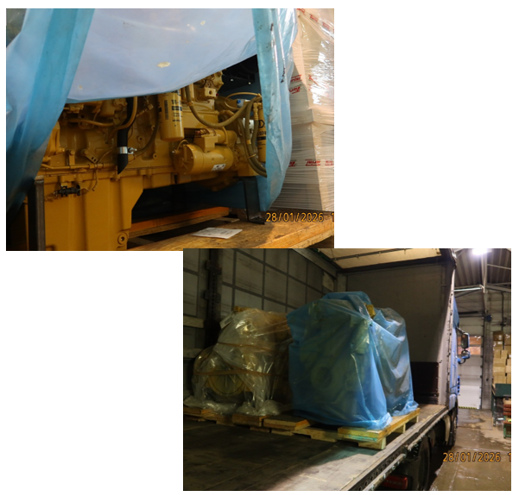
Photos by Customs Board

About the Quarterly Publication

The Financial Intelligence Unit of Latvia publishes quarterly summaries of key sanctions-related developments and statistics in order to provide the public with regular and transparent information regarding sanctions updates and their enforcement in Latvia. The publication is based on information available to the FIU, as well as data provided by the Prosecutor General’s Office, the Court Administration, and the Customs Administration of the State Revenue Service.

1The prohibition is set out in Article 3m of Council of the European Union Council Regulation (EU) No 833/2014: https://eur-lex.europa.eu/legal-content/EN/AUTO/?uri=celex:32025R1494. 

2https://eur-lex.europa.eu/legal-content/EN/TXT/?uri=OJ:L_202600261.

3https://eur-lex.europa.eu/legal-content/EN/TXT/?uri=CELEX%3A02024R2642-20260316.

4https://eur-lex.europa.eu/legal-content/EN/TXT/?uri=CELEX%3A02024R1485-20260223.

5Judgment in joined cases C-696/23 P, C-704/23 P, C-711/23 P, C-35/24 P and C-111/24 P: https://eur-lex.europa.eu/legal-content/LV/TXT/HTML/?uri=CELEX:62023CJ0696.

6 Judgment in case C-84/24: https://eur-lex.europa.eu/legal-content/LV/TXT/HTML/?uri=CELEX:62024CJ0084.

7 Judgment in case C‑465/24: https://eur-lex.europa.eu/legal-content/LV/TXT/HTML/?uri=CELEX:62024CJ0465.

8 In the case, violation of sanctions was one of the criminal offences with which the person had been charged. The term of imprisonment was reduced to 9 years, 8 months and 29 days, applying Section 52 of the Criminal Law.

Other news
Finanšu izlūkošanas dienesta VIII ikgadējā starptautiskā sankciju konference “Sankciju ietekme: graut Krievijas kara spējas” Rīgā, 2026. gada 12. novembrī.
16.11.2026 13:41
FIU Latvia: Coordinated action across EU Member States is key to strengthening sanctions against Russia
More than four years into Russia’s aggression against Ukraine, maintaining and strengthening the impact of sanctions on Russia remains a key priority for Latvia’s and Europe’s security. On 12 November 2026, the Financial Intelligence Unit of Latvia (FIU Latvia) brought together leading sanctions experts and decision-makers in Riga for its eighth annual international sanctions conference. Participants shared experiences and insights on sanctions effectiveness and enforcement, their role in weakening Russia’s war capabilities, and the importance of strengthening border security and resilience. The conference, “Sanctions Work: Degrading Russia’s War Machine”, brought together around 140 experts from 24 countries, including speakers and participants from the United Kingdom, Canada, Ukraine, Germany, France, Belgium, Sweden, Poland and other countries. “How much more money, technology and equipment would Russia have without restrictions that have been made? This is the question we must ask ourselves when assessing the impact of sanctions. More than four and a half years after Russia launched its full-scale invasion of Ukraine, the aggression continues. Sanctions restrict Russia’s access to finance, technology and goods, and reduce the revenues funding the war. Our task is to make that pressure stronger. For Latvia, sanctions have been, and remain, a matter of national security. Latvia’s eastern border is also an external border of the European Union and NATO. Our common security is a shared responsibility. Russia continues to seek new ways around sanctions. We must respond by identifying new routes of circumvention, sharing information promptly and applying restrictions consistently across borders. No institution, and no country, should or can do this work alone. Each sees a different part of the picture. Bringing that knowledge together helps us identify risks and act on them,” said Toms Platacis, Head of FIU Latvia, in his opening remarks at the conference. “Latvia’s geographical location and its borders with Russia and Belarus shape our priorities in addressing sanctions circumvention risks. Particular attention must be paid to export controls, as the recent National Risk Assessment shows that approximately two-thirds of potential sanctions violations identified by customs authorities involve exports to third countries rather than directly to Russia or Belarus. This highlights the significant risk of goods being diverted to Russia through intermediary countries. We therefore work closely with companies exporting high-risk goods and strengthen information sharing with other public authorities and the financial sector. Suspicious transaction reports submitted by banks are particularly important in helping us identify potential sanctions circumvention schemes at an early stage,” emphasises Marta Tilhena, Head of the Sanctions Implementation Division at FIU Latvia.“We have already seen unjustified and premature sanctions relief for Russia, even though it pretends to make “progress” in peace negotiations while destroying Ukraine’s energy and civilian infrastructure with renewed intensity. Meanwhile, the war in the Middle East has bought Russia additional time through windfall energy revenues. But these revenues are nowhere near enough to resolve the structural problems that have accumulated over more than four years of full-scale invasion and sanctions. As the sanctions coalition we must find ways to use economic pressure to finally bring Russia to the negotiating table ready to engage seriously. We have the tools,” explains Yuliia Pavytska, Head of the Sanctions Hub of Excellence at the KSE Institute (Kyiv School of Economics).   Sanctions as a tool for Latvia’s and Europe’s shared security Sanctions restrict Russia’s access to the financing, technology and goods needed to sustain its war. For Latvia, situated on the external border of the EU and NATO, sanctions implementation is a matter of security for the wider region. FIU Latvia plays a key role in this process. Since April 2024, Latvia has centralised responsibility for sanctions implementation within a single institution that combines financial intelligence, sanctions expertise and support for the public and private sectors, helping ensure effective sanctions implementation. Cooperation between EU Member States, competent authorities and the private sector is essential to translating restrictions into tangible results.   European Court of Auditors: Sanctions have had a significant impact, but more can be done The latest report by the European Court of Auditors confirms that EU sanctions have significantly affected trade with Russia, including bringing direct exports of high-priority and dual-use goods to a near halt. The report highlights Latvia as an example of good practice, while also identifying areas for improvement, including stronger coordination between Member States, more consistent customs controls, better information sharing and more effective assessment of the impact of sanctions.   Better risk identification and prevention of sanctions circumvention A recurring message throughout the conference discussions was that the effectiveness of sanctions should not be measured by the number of restrictions adopted or sanctions packages introduced, but by their actual impact on Russia’s ability to finance its war, obtain critical technologies and sustain military production. The conference organised by FIU Latvia reinforced the importance of international cooperation, financial intelligence and practical solutions in further strengthening the impact of sanctions and safeguarding the shared security of Latvia and Europe.   Conference recording in English: https://www.youtube.com/watch?v=xq8QE_40PDY Conference recording in Latvian: https://www.youtube.com/watch?v=NLAoELb8WlI    Photos of the conference: https://flic.kr/ps/47nJko    Presentations: Mihails Kozlovs “The Effectiveness of Implementation of EU Trade Sanctions: Report by the European Court of Auditors” Marta Tilhena “Facilitating Sanctions Implementation by the National Competent Authority” Chloe Cina and Dara Fernandez “Case Study” Gonzalo Saiz Erasquin “The Shadow Crypto Economy Feeding Russia’s War Machine” Tom Robinson “A7: Crypto-Assisted Sanctions Evasion” Mark Handley “The Changing Face of Enforcement of EU Sanctions in 2026” Vicky Edgecombe “Overview of Canada's new compliance program for export controls and sanctions” OTSI “Sanctions End-Use Controls” Yuliia Pavytska “Stepping Up Sanctions Pressure on Russia in a Challenging Geopolitical Environment”   FIU Latvia is an independent authority responsible for preventing money laundering and terrorist financing, implementing sanctions, protecting the Latvian financial system from misuse, and cooperating with international partners. Iveta LocāneFIU Latvia’sHead of Communication Divisionprese@fid.gov.lv
11.11.2026 11:16
Sanctions Work: Degrading Russia’s War Machine - international conference livestreamed on 12 November
The effectiveness of European Union (EU) trade sanctions, Common High Priority (CHP) items and export controls, the role of crypto-assets in sanctions circumvention, sanctions enforcement, and the impact of sanctions on Russia’s economy will be the key topics of the VIII Annual sanctions conference, organised by the Financial Intelligence Unit of Latvia (FIU Latvia). The conference will take place in Riga on Thursday, 12 November 2026, and will be available to watch online in both English and Latvian. The conference will be opened by Toms Platacis, Head of FIU Latvia, followed by Vladyslav Vlasiuk, Advisor-Commissioner of the President of Ukraine for Sanctions Policy, who will share his insights on the role of sanctions in constraining Russia’s ability to wage war. The conference will be moderated by Paulis Iļjenkovs, Deputy Head of FIU Latvia, who will also deliver the closing remarks, highlighting key takeaways on sanctions implementation and the main insights shared throughout the day. The conference in Riga will bring together around 140 participants, including attendees and speakers, from 24 countries, including the United Kingdom (UK), Canada, Ukraine, Germany, France, Belgium, Sweden, Poland and others. Livestream in English: https://www.youtube.com/live/JsTXWAW023Y Livestream in Latvian: https://www.youtube.com/live/Tn3_Fjpz54Q “Every sanctions-related requirement serves a clear purpose: to reduce Russia’s ability to continue its war. As the central authority responsible for sanctions implementation, FIU Latvia helps foster a common understanding and coordinated action to ensure this purpose is reflected in day-to-day decisions,” emphasises Marta Tilhena, Head of the Sanctions Implementation Division at FIU Latvia, who will deliver a presentation on the role of the national competent authority in ensuring effective sanctions implementation. Mihails Kozlovs, Member of the European Court of Auditors, will present the latest findings on the effectiveness of EU trade sanctions. The discussion on the report’s findings, recommendations and way forward will also feature Timothée Truelle, Head of the EU External Relations Division at the French Ministry for Europe and Foreign Affairs, and Raimonds Zukuls, Director of the National Customs Board and Deputy Director General for Customs Issues at the State Revenue Service of Latvia. International experts will discuss export controls and the role of the private sector in sanctions implementation, including Anu Mathur Boyd, Head of Sanctions and Export Controls at Maersk, alongside sanctions experts Chloe Cina and Dara Fernandez. The role of crypto-assets in sanctions circumvention will be examined by Gonzalo Saiz Erasquin, Research Fellow at the Centre for Finance and Security at RUSI, and Tom Robinson, Founder and Chief Scientist at Elliptic, Associate Fellow at RUSI. International experience in combating sanctions violations and export controls will be shared by Vicky Edgecombe, Director at Global Affairs Canada, Mark Handley, Partner at Duane Morris, and representative from the Office of Trade Sanctions Implementation, UK Department for Business, Innovation, Science and Trade. Towards the end of the conference, Yuliia Pavytska, Head of the Sanctions Hub of Excellence at the Kyiv School of Economics Institute, will present findings on the economic impact of sanctions on Russia and discuss ways to increase sanctions pressure. Agenda in English FIU Latvia is an independent authority responsible for preventing money laundering and terrorist financing, implementing sanctions, protecting the Latvian financial system from misuse, and cooperating with international partners.
15.10.2026 08:00
International conference “Sanctions Work: Degrading Russia’s War Machine” to be streamed live on 12 November
The Financial Intelligence Unit of Latvia (FIU Latvia) invites the public to watch the livestream of its 8th annual international sanctions conference “Sanctions Work: Degrading Russia’s War Machine” online, on 12 November, starting at 10:00 (Riga time). Livestream in English: Livestream in Latvian: The conference will bring together leading sanctions experts and policymakers to discuss the effectiveness of sanctions and the fight against sanctions violations, their role in reducing Russia’s warfighting capabilities, as well as strengthening global security and resilience. This year, the conference will focus on the practical impact of sanctions on Russia’s ability to continue its war. Experts will examine which sanctions measures have delivered concrete and measurable results in practice, with particular attention to experience and best practices in sanctions implementation, enforcement, and tackling sanctions violations. The conference will also feature a presentation of a report by the European Court of Auditors assessing how effectively the European Union implements trade-related sanctions imposed on Russia, with a particular focus on the roles of the European Commission and EU Member States in their enforcement. The conference programme will focus on three key topics: Export restrictions on Common High Priority (CHP) items – effective approaches to preventing these goods from reaching Russia and disrupting supply chains that support its military-industrial capabilities, including efforts to counter diversion through third countries and other sanctions-circumvention techniques. The role of crypto-assets in sanctions circumvention – including the use of crypto-assets to facilitate payments linked to CHP items and other restricted goods. Energy sanctions and other measures aimed at reducing Russia’s revenues – measures that have proven effective in restricting Russia’s energy revenues and capabilities, methods used to circumvent energy-sector sanctions, and the role of the shadow fleet. The conference will bring together distinguished speakers such as Head of the Sanctions Hub of Excellence at Kyiv School of Economics Institute Yuliia Pavytska, Head of EU External Relations Division at French Ministry for Europe and Foreign Affairs Timothée Truelle, Head of Sanctions and Export Controls at Maersk Anu Mathur Boyd, along with other leading experts from the public and private sectors across the EU and the United Kingdom. Agenda in English FIU Latvia is an independent authority responsible for preventing money laundering and terrorist financing, implementing sanctions, protecting the Latvian financial system from misuse, and cooperating with international partners.