breadcrumb arrow breadcrumb arrow
Read news
The price of war: how sanctions affect Russia's future
30.12.2025.

How are sanctions weakening the Russian economy, and how can their impact be assessed? In this article Paulis Iļjenkovs, Deputy Head of the Financial Intelligence Unit (FIU) for Sanctions, and Benjamin Hilgenstock, Head of the Macroeconomic Research and Strategy Department at the KSE Institute of the Kiev School of Economics, analyze how sanctions are affecting the Russian economy, assess their effectiveness, and consider what changes are still needed.

Sanctions are working, but there is still much work to be done

Since Russia's full-scale invasion of Ukraine in February 2022, the European Union (EU) has adopted 19 rounds of sanctions against Russia, adding to measures already in place following the illegal annexation of Crimea in 2014.

“Since sanctions must be renewed every six months with the unanimous consent of all EU member states, political resistance can significantly weaken their effectiveness,” says B. Hilgenstock.

B. Hilgenstock adds that this explains why some member states are still importing Russian energy resources more than three and a half years after the start of a full-scale war. However, despite these restrictions, the EU has made significant progress - the unexpected agreement to ban the transport of Russian liquefied natural gas (LNG) to Europe shows that sanctions can be effectively improved .

P. Iļjenkovs draws attention to additional challenges faced by companies, financial institutions and Member States. Although decisions on sanctions are taken centrally, each Member State is responsible for their actual implementation. This has led to decentralization and fragmentation of sanctions implementation at the Member State level. For example, a large number of countries have not yet introduced criminal liability for violation of sanctions in accordance with the EU Directive. Sanctions enforcement shortcomings can also occur within the borders of one country. To mitigate such a risk, Latvia has designated the Financial Intelligence Unit as the competent authority for sanctions enforcement issues.

Both experts point out that the implementation of sanctions is improving, but further efforts are still needed. “For sanctions to become truly effective, targeted and long-term sustainable investments are needed,” emphasizes P. Iļjenkovs.

Sanctions that have caused the greatest damage to Russia

When asked which sanctions have caused the greatest damage to Russia, both experts agree that the most significant impact has been caused by restrictions targeting the energy sector. The EU embargo on crude oil and petroleum products significantly limited Russia’s access to the European market. This forced Russia to look for new buyers in other markets in early 2023, often selling oil at significant discounts, which resulted in a significant decrease in revenue. The KSE Institute estimates that Russia has lost $159 billion in potential revenue between March 2022 and August 2025 (see Figure 1).
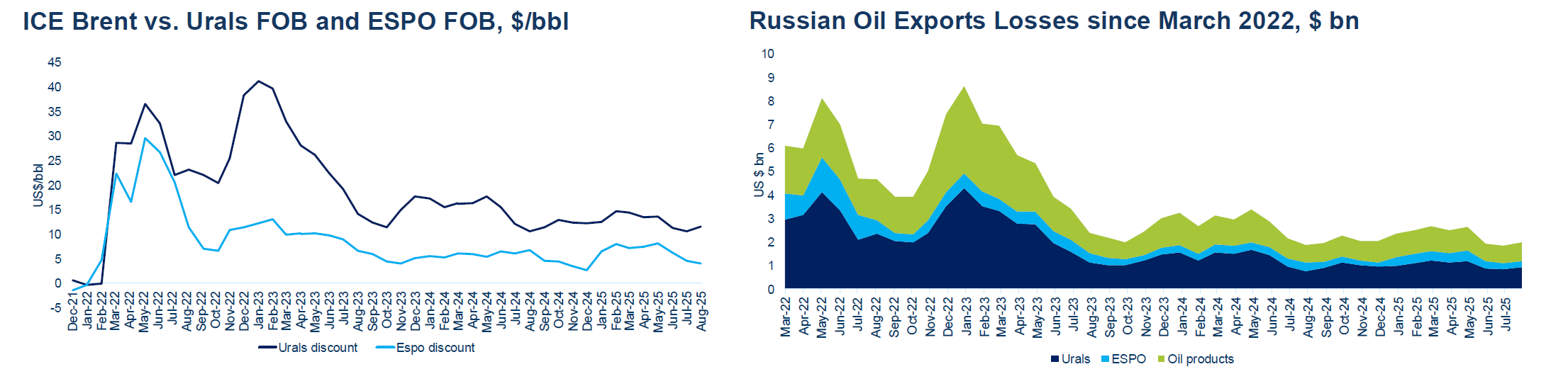
 

Figure 1. Comparison of Russian and European oil prices (left) and estimates of Russian oil export losses (right). Sources: IEA Oil Market Reports; KSE Institute estimates.

According to both experts, the next most important are export control sanctions on dual-use goods and other high-priority goods. Although European-origin technologies continue to find their way into Russian military equipment and evidence suggests that sanctions have not completely stopped the purchase of Western-made components through complex supply chains, such purchases often occur at significantly higher costs than under normal market conditions. B. Hilgenstock suggests that this may be due both to the large number of intermediaries in sanctions-evasion schemes and to the fact that Chinese suppliers, aware of Russia’s dependence on these technologies, charge higher prices.

Financial sanctions are equally important. P. Iļjenkovs also highlights sanctions targeting Russian oligarchs, whose influence determines the Kremlin's decision-making. B. Hilgenstock, in turn, highlights the freezing of the Russian Central Bank's assets in the EU, noting that the loss of access to foreign reserves limits policy-making opportunities, promotes high interest rates, and further destabilizes the ruble.

Impact of the latest sanctions on Lukoil and Rosneft

In October 2025, the US Office of Foreign Assets Control (OFAC) imposed new sanctions on Rosneft and Lukoil, the two largest Russian oil companies. As B. Hilgenstock points out, the initial impact will be significant, as OFAC clearly signals the risk of secondary sanctions on foreign banks. In order to maintain export volumes, Russia will have to offer even greater discounts on the already low price of oil.

How long this period will last is not yet clear, as both experts agree that the effectiveness of these sanctions will depend on how rigorously OFAC enforces them. Some exemptions have already been granted, which reduce the effectiveness of the sanctions. There is also the possibility that Russia could set up shell companies to purchase the sanctioned oil and then resell it, eliminating the names of Rosneft and Lukoil from the transactions and thus allowing banks to process the payments. Whether OFAC will take a strong stance against such potential circumvention schemes is still an open question.

P. Iļjenkovs points out that Lukoil's significant presence in the European fuel retail market makes the company particularly vulnerable to the impact of sanctions . At the same time, the impact on Latvia is likely to be minimal, as Rosneft has actually been considered a subject of sanctions since 2022, taking into account the inclusion of its CEO Igor Sechin on the sanctions list, while Lukoil's business presence in Latvia is small.

The protracted war and the resilience of the Russian economy

After more than three and a half years, Russia's aggression against Ukraine continues, raising questions about what the duration of the war reveals about the state of the Russian economy.

B. Hilgenstock points out that waging a prolonged war outside one’s own territory is extremely expensive, although an authoritarian regime can sustain such aggression for a long time. At the same time, Russia is not invincible – it failed to achieve its initial military goal of capturing Kiev in three days, and its progress on the front has been slow and very costly. “The duration of the war shows that the pressure applied so far has not been sufficient – ​​it must be intensified,” concludes B. Hilgenstock.

Sanctions have significantly weakened Russia's economy and its war-making capabilities , but their long-term effectiveness depends on continued coordination, consistent implementation, and political will. Maintaining and intensifying this pressure is crucial for the international community to effectively support Ukraine and constrain Russia's ability to continue its aggression.

The conversation took place during the conference "Protecting the Border: Sanctions, Export Control and Corporate Responsibility" organized by FIU, which served as an important platform for dialogue between experts, policymakers and business people to strengthen a common understanding of the importance of sanctions and the effectiveness of their implementation.

Conference recording (in Latvian)

Conference recording (in English)

Sanctions lists and other useful information available on the FID website.

Since April 2024, the FIU has been the national competent authority for sanctions implementation in Latvia.

Other news
06.07.2026 12:00
FIU Latvia publishes updated guidelines on the assessment of control of designated public officials
The Financial Intelligence Unit of Latvia (FIU Latvia) has updated its guidelines, "Assessment of control of designated public officials." The guidelines explain how to assess the control criterion in situations where control over a legal person, public authority, or state-owned enterprise that is not itself subject to sanctions may be exercised by a public official designated under financial sanctions. Targeted financial sanctions apply not only to persons directly designated in sanctions lists, but also to legal persons, entities or bodies that are owned or controlled by designated persons. Consequently, assessing the control criterion is one of the most complex aspects of implementing targeted financial sanctions in practice, and a consistent approach to such assessments is essential for ensuring the effective implementation of sanctions and legal certainty. Due to Latvia's geographical location and historical economic ties, persons in Latvia may encounter public authorities and state-owned enterprises of Russia and Belarus. Therefore, the purpose of the guidelines is to promote consistent sanctions implementation practices and legal certainty by explaining the FIU's approach to assessing control in situations where a designated public official may exercise it. The second updated version has been prepared to align the guidelines with amendments to Council Regulation (EU) No 269/2014, introducing definitions of "owning a legal person, entity or body" and "controlling a legal person, entity or body" in Article 1 of the Regulation. Although the institutions of the European Union had previously clarified the criteria to be considered when assessing ownership and control for sanctions purposes, these amendments harmonise and expressly incorporate those legal concepts into Regulation (EU) No 269/2014. Consequently, the FIU's approach to assessing control has not changed in substance. "Assessment of control of designated public officials." Since April 2024, FIU Latvia has been the national competent authority for sanctions implementation in Latvia, working with Latvian and international partners to strengthen the effectiveness of sanctions.
15.06.2026 11:29
EU updates sanctions lists
On 15 June 2026, the Council of the European Union (EU) adopted a decision to expand sanctions lists related to Russia by imposing restrictive measures on additional persons. The changes include additions to the lists of natural and legal persons subject to targeted financial sanctions in connection with Russia’s illegal war in Ukraine, Russia’s hybrid threat activities, and human rights violations. Persons included in the sanctions lists are subject to asset freezes, and EU citizens and companies are prohibited from making funds or economic resources available to them. Individuals are also subjected to travel restrictions, preventing them from entering or transiting through the territory of the EU. Notably, these additions to the sanctions list were adopted outside the EU’s broader sanctions package, signaling a more flexible and responsive approach to sanctions adoption. Learn more about the updated sanctions lists: https://eur-lex.europa.eu/legal-content/LV/TXT/?uri=OJ:L_202601361https://eur-lex.europa.eu/legal-content/LV/TXT/?uri=OJ:L_202601356https://eur-lex.europa.eu/legal-content/LV/TXT/?uri=OJ:L_202601362 Since April 2024, FIU Latvia has been the national competent authority for sanctions implementation in Latvia, working with Latvian and international partners to strengthen the effectiveness of sanctions.
22.05.2026 11:49
Key Sanctions Developments in Q1 2026
SUMMARY EU is strengthening sanctions against Russia, including banning the import of petroleum products produced from Russian crude oil and approving a gradual phase-out of Russian natural gas.Krievijas dabasgāzes.EU is expanding sanctions lists in response to human rights violations and Russia’s destabilising activities.The Court of Justice of the European Union confirms broader application of sanctions to companies and prohibits sanctioned persons from participating in shareholders’ meetings.In Latvia, 24 new criminal proceedings have been initiated for violations of international sanctions.Latvian courts completed adjudication in 11 sanctions-related cases, with several resulting in fines and imprisonment.The Customs Board of the State Revenue Service initiated 29 administrative offence proceedings.Guidance on the application of sanctions has been updated. Strengthening of SanctionsOn 21 January, a ban entered into force in the European Union (EU) on the import of petroleum products manufactured from Russian crude oil.¹ Although the EU had already prohibited imports of Russian crude oil (except via pipelines), it had until now remained permissible to import petroleum products manufactured in third countries using Russian crude oil.On 26 January, a regulation was adopted approving the EU’s gradual phase-out of Russian natural gas.² The import ban entered into force on 18 March, while transitional periods for the fulfilment of existing contracts will remain in place until the end of 2027. Specific exemptions are also предусмотрены for landlocked countries.Although the 20th sanctions package was adopted on 23 April, during the first months of the year the EU expanded sanctions regimes targeting Russia’s “hybrid warfare”³ activities and human rights violations. On 23 February, the EU imposed sanctions on eight Russian individuals for serious human rights abuses and acts of repression. In addition, the sanctions list related to Russia’s destabilising activities was expanded by 10 individuals, primarily authors and distributors of Russian propaganda.Key Judgments of the Court of Justice of the European UnionOn 26 March, the Court of Justice of the European Union dismissed appeals submitted by five sanctioned individuals — Dmitry Alexandrovich Pumpyanskiy, Tigran Khudaverdyan, Viktor Filippovich Rashnikov, Dmitry Arkadievich Mazepin, and German Khan — who sought the annulment of sanctions imposed against them.⁵ The joined cases are particularly significant because the Court interpreted the criterion of an “influential businessperson” for inclusion on sanctions lists. The Court confirmed that a person may justifiably be sanctioned even without direct links to the Russian government if the individual is economically influential or operates in a sector constituting a substantial source of revenue for the Russian government.Additional important sanctions-related judgments were delivered on 12 March. The Court confirmed⁶ that the assets of a company owned or controlled by a sanctioned person may also be frozen even if the company itself is not listed under sanctions, provided that at least 50% of its shares are owned by a sanctioned individual.In another judgment,⁷ the Court ruled that persons included on sanctions lists are not permitted to participate in shareholders’ meetings or exercise voting rights therein.FIU TopicalitiesDuring the first quarter, the Financial Intelligence Unit of Latvia received 310 suspicious transaction reports indicating possible sanctions violations or attempted violations. Most reports concerned the possible shipment of prohibited goods to Russia through third countries, the provision of services to Russian companies, accounts held in sanctioned banks, and the transportation of cash to Russia. A total of 51 analytical reports relating to possible sanctions violations were forwarded to law enforcement and other authorities.On 20 February, the FIU adopted a new General Authorisation, expanding the categories of payments for which sanctioned persons no longer require separate FIU permission.The FIU also repeatedly updated the “Frequently Asked Questions” section of its website regarding sanctions implementation, clarifying existing guidance and adding new questions. New explanations were provided, for example, regarding the provision of services to Russian and Belarusian companies, the obligation to comply with EU sanctions in third countries, the holding of shares in Russia or Belarus, framework agreements, the transit of goods through the EU, and the FIU General Authorisation.By the end of the first quarter of 2026, the following assets owned or controlled by sanctioned persons had been frozen in Latvian financial institutions and state registers: funds — EUR 152.2 millionreal estate properties — 103vehicles — 66agricultural machinery — 11vessel — 1livestock herd — 1trademarks — 12 A list of sanctioned persons with frozen assets in Latvia is available here.Criminal Proceedings Statistics in LatviaDuring the first quarter of 2026:24 new criminal proceedings were initiated for violations of international sanctions;criminal prosecution was commenced in six criminal proceedings;charges were brought against seven natural persons;five criminal proceedings were referred to court;two criminal proceedings were completed through prosecutorial penalty orders.In one of the proceedings concluded through a prosecutorial penalty order, a natural person was fined EUR 9,360, while a legal entity was ordered to pay more than EUR 17,100. The case concerned an attempt to export sanctioned goods — primer products valued at EUR 67,800 — to Russia using falsified documents and falsely declaring Kazakhstan as the final destination. The goods had already been confiscated, sold, and the proceeds transferred to the state budget.In another criminal proceeding concluded through a prosecutorial penalty order, a Russian citizen holding a permanent residence permit in Latvia was placed under probation supervision for three years. In this case, the individual knowingly violated EU sanctions against the Russian Federation for financial gain by remotely working as a programmer (1C developer) for a Russia-registered company and thereby systematically providing prohibited IT consultancy services. Between 2022 and 2025, the individual received remuneration amounting to 5.89 million Russian roubles (approximately EUR 64,200). Part of this remuneration — nearly EUR 10,000 — was received through an account held with a sanctioned bank, thereby directly making funds available to a sanctioned legal entity.In Latvian CourtsDuring the first months of the year, Latvian courts completed adjudication in 11 criminal cases related to sanctions violations.In one case, a judgment entered into force imposing fines exceeding EUR 26,500 on two individuals. In two other cases, criminal proceedings were terminated after the court concluded that no criminal offence had occurred.A further six individuals were convicted in cases where judgments had not yet entered into force by the end of the quarter. In two cases, imprisonment sentences of 11 years⁸ and three years respectively were imposed. The largest fine imposed on a natural person amounted to EUR 31,200, while the largest monetary recovery ordered against a legal entity amounted to EUR 39,000.Customs Board TopicalitiesThe Customs Administration of the State Revenue Service of Latvia initiated 29 administrative offence proceedings related to sanctions violations.Overall, during the reporting period, 187 consignments were denied border crossing due to sanctions violations or suspicions of sanctions circumvention. Most rejected consignments concerned exports. The most frequently blocked exports included spare parts for various devices and machinery, electrical equipment and components, and vehicle spare parts. Imports from Russia and Belarus involving construction structures, timber, iron compounds, and furniture were also denied.In an additional 43 cases, attempts were identified to export cash denominated in official EU Member State currencies from the EU in violation of sanctions regulations. Postal controls prevented 31 violations, while 42 cases involved individuals attempting to transport sanctioned goods across the border.Example of a Sanctions ViolationOn 23 January 2026, at the Pāternieki Customs Control Point, customs officials identified an attempt to transport engines to Belarus. Although the declared recipient was located in Kazakhstan, the engines in question were also prohibited from transit through Russia and Belarus. The total value of the goods amounted to EUR 102,000. Criminal proceedings were initiated in connection with the case. Photos by Customs Board About the Quarterly PublicationThe Financial Intelligence Unit of Latvia publishes quarterly summaries of key sanctions-related developments and statistics in order to provide the public with regular and transparent information regarding sanctions updates and their enforcement in Latvia. The publication is based on information available to the FIU, as well as data provided by the Prosecutor General’s Office, the Court Administration, and the Customs Administration of the State Revenue Service. 1The prohibition is set out in Article 3m of Council of the European Union Council Regulation (EU) No 833/2014: https://eur-lex.europa.eu/legal-content/EN/AUTO/?uri=celex:32025R1494.  2https://eur-lex.europa.eu/legal-content/EN/TXT/?uri=OJ:L_202600261. 3https://eur-lex.europa.eu/legal-content/EN/TXT/?uri=CELEX%3A02024R2642-20260316. 4https://eur-lex.europa.eu/legal-content/EN/TXT/?uri=CELEX%3A02024R1485-20260223. 5Judgment in joined cases C-696/23 P, C-704/23 P, C-711/23 P, C-35/24 P and C-111/24 P: https://eur-lex.europa.eu/legal-content/LV/TXT/HTML/?uri=CELEX:62023CJ0696. 6 Judgment in case C-84/24: https://eur-lex.europa.eu/legal-content/LV/TXT/HTML/?uri=CELEX:62024CJ0084. 7 Judgment in case C‑465/24: https://eur-lex.europa.eu/legal-content/LV/TXT/HTML/?uri=CELEX:62024CJ0465. 8 In the case, violation of sanctions was one of the criminal offences with which the person had been charged. The term of imprisonment was reduced to 9 years, 8 months and 29 days, applying Section 52 of the Criminal Law.