19.04.2024 14:58
Conference “Effective sanctions: goals for 2024”
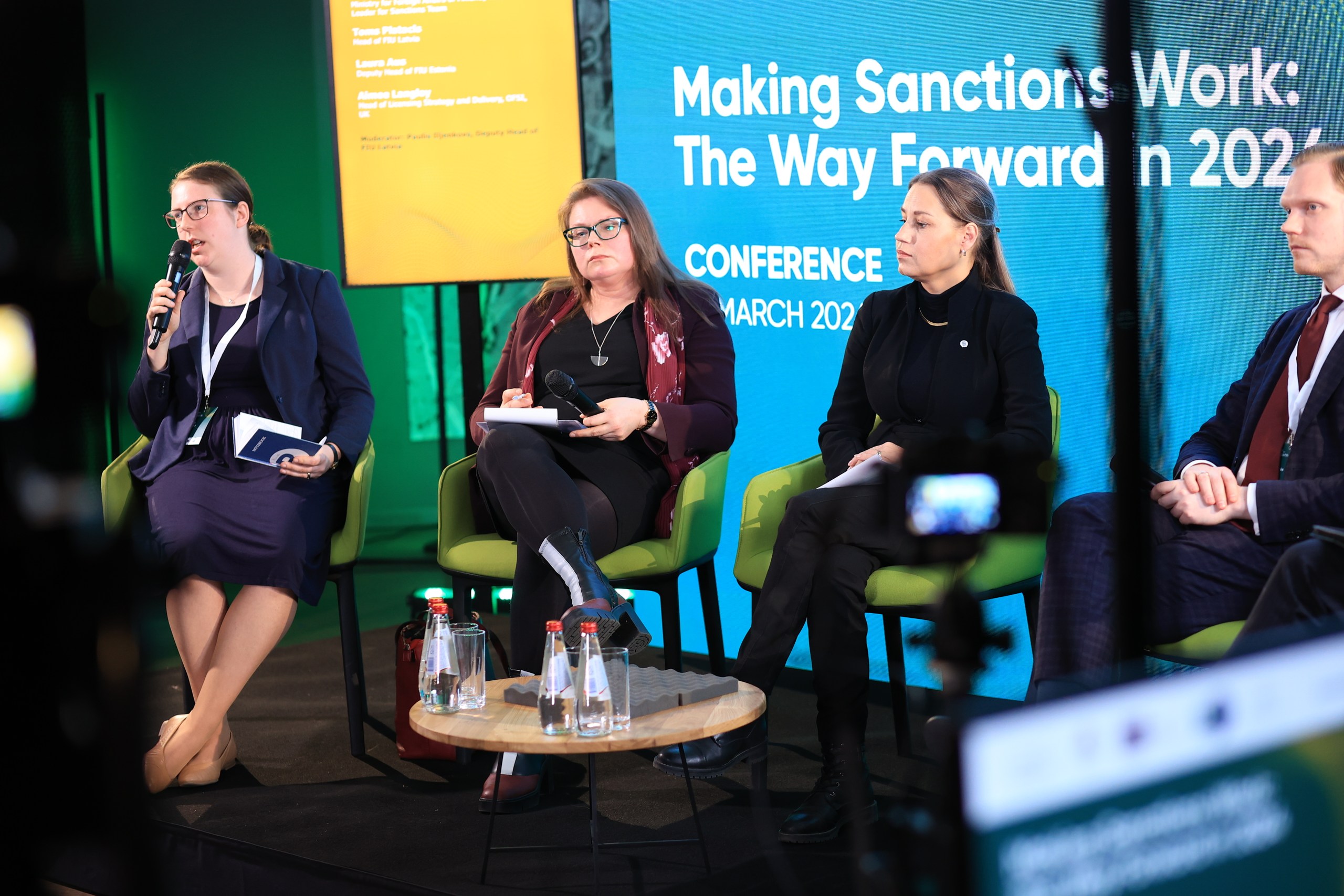
The conference was organised with the support of the EEA grant under the project “Improvement of staff knowledge in combating money laundering in Latvia” (No. EEZ/FID/2021/6). Information on the EEA Financial Instrument: www.eeagrants.lv. Working together for secure and competitive Europe! On 19 March of this year, Rīga hosted the international conference “Effective sanctions: goals for 2024”, which brought together more than 1000 participants, 100 of them in person and 900 remotely. The aim of the conference was to discuss improvement of the application and implementation of sanctions in the European Union (EU). The conference brought together 21 international experts from 9 countries, representing public authorities, financial institutions, and the industry, to exchange experiences and discuss ways to strengthen the application and implementation of sanctions at operational level across the EU. The event was opened by Toms Platacis, the Head of the Financial Intelligence Unit of Latvia (FIU Latvia), who informed of the new role of the FIU Latvia as the leading authority in matters related to sanctions implementation in Latvia. Thereafter the Minister for the Interior of the Republic of Latvia Rihards Kozlovskis emphasised the crucial role of sanctions in national security, in particular against Russia’s actions in Ukraine. In his speech, EU Special Envoy for Sanctions David O’Sullivan highlighted the impact of sanctions on reduced energy profits of Russia and on its military capabilities. The conference discussed a wide range of topics, including: Vladyslav Vlasiuk, the advisor in the Ukrainian presidential office, in conversation with Tom Keatinge, Director of RUSI’s Centre for Financial Crime and Security Studies, stressed the need to strengthen sanctions and their implementation in order to deter Russia’s military capabilities. Mr Vlasiuk urged Ukraine’s allies to notice what the sanctions have achieved. Russia is struggling to obtain key microelectronic components for its Shahed drones, which are increasingly failing because they have to use lower quality components. Mr Vlasiuk insisted on the importance of decisive action and identified three priorities: to achieve the confiscation of Russian assets, to strengthen the implementation of the Oil Price Cap, and to cooperate with the international financial institutions after the US December 2023 executive order. In the first panel discussion “How to ensure an effective sanctions implementation model in a country?”, moderated by the FIU Latvia Deputy Head Paulis Iļjenkovs, representatives of various national competent authorities discussed their different powers and responsibilities in their respective implementation models, their role in applying exceptions, as well as the support they provide to the private sector in the implementation of sanctions. The Latvian and Estonian financial intelligence units, the Finnish Ministry of Foreign Affairs, and OFSI, which is a separate body in the United Kingdom dealing with the implementation of financial sanctions, took part in the discussion as national competent authorities. The discussion described the positive aspects of centralised competent authorities, while concluding that there is no singular model of authority that is clearly more successful than others. It was concluded that greater effort is needed to ensure the effectiveness of these models and also it is necessary to foster cooperation with the private sector. In conclusion, a discussion was held on the need for the EU to establish a centralised structure for the implementation of sanctions, a proposal that was also supported by FIU Latvia.Tom Keatinge and Kinga Redlowska, Head of RUSI’s European Centre for Financial Crime and Security Studies, discussed the role of research in the effectiveness of sanctions. RUSI is committed to improving knowledge and awareness of sanctions across Europe and in early 2022 launched the Sanctions and Illicit Finance Monitoring and Analysis Network (SIFMANet). SIFMANet has organised more than a dozen discussions in EU Member States, bringing together the public and private sectors to assess the situations faced by organisations in the application and implementation of sanctions. Both authorities and companies are committed to their responsibilities, but researchers support strengthening the strategic vision and helping to identify policy and operational gaps to achieve a stronger sanctioning framework.Benjamin Hilgenstock, Senior Economist at Kyiv School of Economics, joined RUSI Research Analyst Gonzalo Saiz for a discussion on the current impact of sanctions on Russia and ways to improve the application and implementation of sanctions. Mr Hilgenstock emphasised the negative impact of sanctions on Russia’s energy revenues, as well as military and industrial complex, but pointed out that the pace of impact is too slow. He stressed the need to tighten the Oil Price Cap to limit Russia’s ability to finance the war. Export controls should also be strengthened, in particular by supporting non-financial operators with limited experience in sanctions implementation. The discussion concluded by underlining that strong sanctions and export control regimes are essential for national security and that ensuring their effectiveness should remain a priority beyond the current focus on Russia in order to respond to future threats.The panel discussion “Combating the sanctions evasion” brought together authorities from different EU Member States to discuss the level and effectiveness of sanctions implementation measures. The panellists agreed that identifying Russian assets is not an easy task, as they are often hidden behind complex ownership structures and cross-border networks. Many national authorities were not fully prepared to comply with a series of sanctions imposed in February 2022. Ruud Leeuwendaal, Head of Team Anti-Terrorism Financing and Sanctions in the Netherlands, explained how Member States have consistently stepped up their efforts, especially in view of the new risks of circumvention when trade is routed through third countries. Lars Schmidt, Director and Sanctions Coordinator at the Swedish Ministry of Foreign Affairs, presented his country’s initiative to distribute a sanctions leaflet with the help of the Swedish authority to exporters in order to inform them of their responsibilities, provide support, and encourage vigilance. The discussion concluded with information on the measures to be taken to prevent and deter future infringements.Pierre-Arnaud Lotton, Sanctions Policy Officer at DG for Financial Stability, Financial Services and Capital Markets Union (FISMA), had a discussion with Marta Tilhena, Head of Sanctions Implementation Division at the FIU Latvia, about the European Commission’s efforts to support the application and implementation of sanctions across the EU. It was concluded that there has been an increased policy focus on combating sanctions evasion through new measures such as the extension of the transit ban through Russia or the new requirement to include a “ban on re-export to Russia” clause in contracts, but that it is also important to ensure that these measures are implemented. While there is still a lack of coherence across Member States in such matters as “control” over legal entities, the Commission is committed to continuing to raise awareness, use information exchange tools, and provide guidance on how to prevent inconsistencies and promote common understanding.The panel discussion “Strengthening cooperation of public and private sectors” highlighted the important role of the private sector in sanctions implementation. Emil Dall, Senior Consultant and Sanctions Lead at FINTRAIL, highlighted how the unprecedented scale of sanctions has changed the international compliance landscape, with the EU and the United Kingdom at the centre of a sanctions landscape traditionally dominated by the US. Laima Letiņa, Finance Latvia Association Advisor, highlighted the insufficient readiness of bank clients to comply with sanctions, which increases the administrative burden on financial institutions, requiring more manual work to conduct enhanced due diligence on clients and their business activities. Gem Conn, Vice President of Content Strategy and Quality, Risk and Compliance at Dow Jones, concluded by calling on institutions to publish as much information as possible on sanctions lists to facilitate these growing compliance tasks, prevent false positives, and improve the quality of suspicious transaction reports.In a remote conversation with Tom Keatinge, Michael Khoo, Co-Director of the Task Force KleptoCapture, explained the Task Force’s efforts to ensure the implementation of sanctions and export control regimes, to obtain evidence of sanctions violations and circumvention, and to prosecute and convict perpetrators. Other international initiatives, e.g. the G7 Working Group “Russian Elites, Proxies and Oligarchs” (REPO), have also contributed to these efforts. However, Mr Khoo concluded that there are still problems in this area. Many jurisdictions still do not criminalise the circumvention of sanctions, which hampers mutual legal assistance requests. The forthcoming EU Directive, which will criminalise sanctions violations, should bridge this gap. The FIU Latvia Deputy Head Paulis Iļjenkovs concluded the conference with the main conclusions of the discussions, paving the way for future cooperation between the main sanction stakeholders in the EU and pointing to the example that the FIU Latvia can set for other Member States to centralise their sanctioning competences in order to promote effective application and implementation of sanctions. The full recording of the conference is available here. The conference was organised under the EEA Financial Mechanism period 2014–2021 programme “International Police Cooperation and Combating Crime” project No. EEZ/FID/2021/6 “Improvement of staff knowledge in combating money laundering in Latvia”